Best Types of Screen Protectors: Which One Should You Buy?
Published: 24 Oct 2026
Your phone screen is costly. Do you want to risk a crack? One drop can break it, and one scratch can spoil its look. A screen protector helps stop this damage. But there are many types of screen protectors. Some use glass, some use film, and others use liquid. So which one is right for you? This guide makes the choice easy. You will learn the best types of screen protectors and how each one differs. Let’s find the best fit for your phone and your budget.
What Is a Screen Protector, and Do You Need One?
A screen protector is a thin cover for your phone screen. It takes the hit so your real screen stays safe.
It protects your phone from:
- Scratches
- Small drops
- Dust
Most phone screens use strong glass. But strong glass can still scratch. Think about your pocket. Do you keep keys or coins there? These hard things rub on your screen all day. Tiny scratches build up, and your phone looks old fast. So, is a screen protector worth it? For most people, yes. It costs much less than a screen repair. It also keeps your phone looking new, so you get a better price when you sell it.
Do you drop your phone often? A screen protector is a smart buy.
Best Types of Screen Protectors at a Glance
Short on time? This list shows the main types of screen protectors side by side.
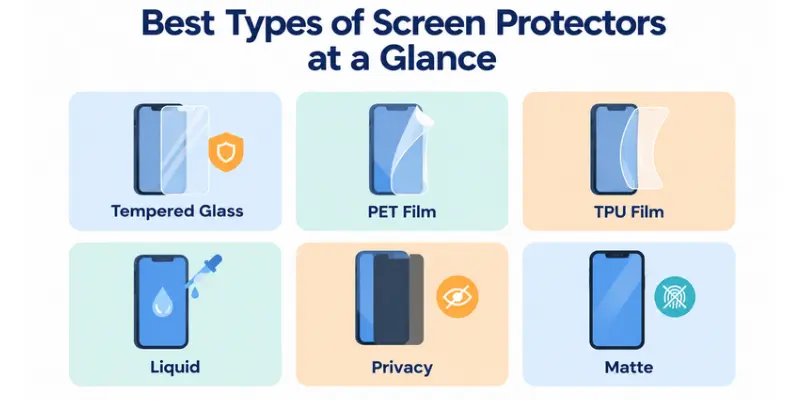
- Tempered glass
- Made of hard glass
- Feels smooth, like the real screen
- Gives high protection
- Costs a medium price
- PET film
- Made of thin plastic
- Feels slightly plastic
- Gives low protection
- Costs a low price
- TPU film
- Made of soft, bendy plastic
- Feels soft and smooth
- Gives medium protection
- Costs a low to medium price
- Liquid
- Made of a clear coating
- Feels almost like nothing
- Gives low protection
- Costs a medium price
- Privacy
- Made of glass or film
- Feels smooth
- Gives medium protection
- Costs a medium to high price
- Matte
- Made of glass or film
- Feels slightly rough
- Gives medium protection
- Costs a medium price
Quick tip: Want the best protection? Pick tempered glass. Want a cheap fix? Pick PET film.
Want more detail? Keep reading. Each type has its own section below.
Tempered Glass Screen Protectors
Tempered glass is the most popular choice today. It is real glass that goes through heat to become strong. Many people call it the best protector for daily use.
What Is It?
You may see “9H hardness” on the box. This number shows how hard the glass is. 9H is the top level on the pencil hardness scale. It means the glass resists scratches from keys and coins.
Think of it as a shield. When your phone falls, the shield may crack. Your real screen often stays safe.
Pros
- Feels smooth, just like your real screen
- Resists scratches very well
- Absorbs the hit from small drops
- Stays clear and sharp
- Wipes clean easily
Cons
- Can crack or chip on a hard drop
- Costs more than plastic film
- Can add a little thickness
- Edges may lift if the fit is poor
Does a crack mean the protector failed? No. It did its job. You replace the glass and keep your screen.
Best For
Tempered glass suits people who:
- Drop their phone often
- Want the best touch feel
- Want strong, long-lasting protection
Quick tip: Pick a glass protector that fits your case. A bad fit leaves gaps or lifts the edges.
Plastic Film Screen Protectors
Film protectors are thin plastic sheets. They cost less than glass. They also bend and stick well. There are two main types: PET and TPU.
PET Film
PET is a thin, hard plastic. It is the most basic type of film.
Pros
- Costs very little
- Stops everyday scratches
- Feels light and thin
Cons
- Gives weak drop protection
- Feels a bit plastic
- Can show bubbles during installation
Best for: People who want a cheap, quick fix. It also suits a spare phone or a child’s phone.
TPU Film
TPU is a soft, bendy plastic. It stretches a little. That helps it fit curved screens.
Pros
- Fits curved edges well
- Heals light scratches by itself
- Absorbs small bumps
- Feels soft and smooth
Cons
- Can look slightly cloudy
- Can turn yellow over time
- Does not stop deep scratches
Think of a tiny scratch on a TPU film. Leave it for a day. It may fade away.
Best for: People with curved-screen phones. It also suits those who want a thin, flexible cover.
Liquid Screen Protectors
A liquid screen protector is a clear coating. You wipe it on your screen. It dries into a thin, invisible layer. There is no sheet to stick.
Do They Really Work?
Yes, but only in a small way. The coat helps stop light scratches and smudges. It does not stop a hard drop. Think of it as a light jacket, not a helmet.
Pros
- Feels like nothing is there
- Fits any shape, even odd ones
- Adds no thickness
Cons
- Gives weak drop protection
- Wears off over time
- Needs a careful, even wipe
Best for: People who want a thin, clean look. It also suits phones with odd shapes.
Quick tip: Want strong protection? Pair a liquid coat with a good case.
Special Types: Privacy, Matte, and Anti-Glare
Some protectors do more than stop scratches. They add extra features. Here are the most common ones.
Privacy
A privacy protector hides your screen from side views. Only you can see it clearly. Do you use your phone on a bus or train? This type keeps nosy eyes away.
Trade-off: The screen looks a little darker.
Matte
A matte protector cuts glare and fingerprints. Your finger glides over it with ease. Gamers love this feel.
Trade-off: The screen can look slightly blurry. Some people also see a grainy “orange peel” look.
Anti-Glare
This type reduces shine from lights and the sun. It helps when you use your phone outside.
Other Terms You May See
- Blue light: Blocks some of the light that tires your eyes.
- HD: Stays very clear, with no blur.
- Hydrophobic: Pushes water and oil away.
Quick tip: Pick one extra feature that fits your daily life.
Tempered Glass vs Film: Which Is Better?
This is the most common question buyers ask. The answer is simple. It depends on what you need.
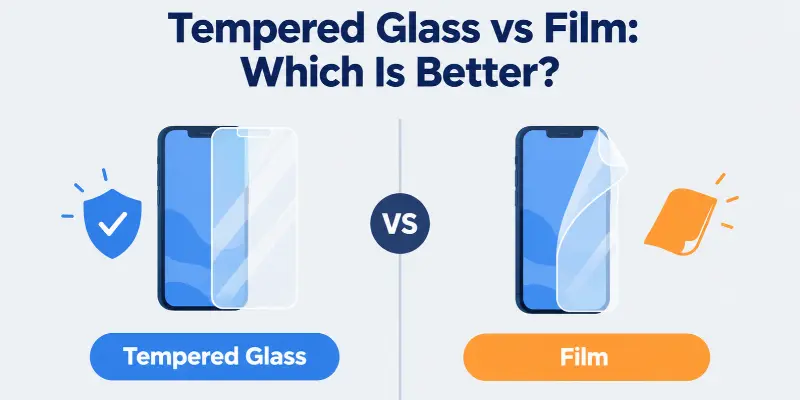
Choose Tempered Glass If You Want:
- Better protection. It takes the hit when you drop your phone.
- A smooth feel. It feels like your real screen.
- A sharp view. It stays clear for a long time.
Choose Film If You Want:
- A low price. Film costs less than glass.
- A good fit on curved screens. Film bends with the edges.
- A thin, light cover. It adds almost no weight.
What About Installing?
Both are easy to apply with some care. Glass often comes with a guide frame. It helps you place it right. Film can trap bubbles, so keep your screen clean.
Short Answer
Most people should pick tempered glass. It protects better and feels better.
Do you have a tight budget or a curved screen? Then pick film.
What Is the Best Material for a Screen Protector?
The best material is tempered glass. It resists scratches, absorbs drops, and feels smooth.
But the best choice depends on how you use your phone. Ask yourself:
- Do you drop your phone often? Pick tempered glass.
- Do you want a low price? Pick PET film.
- Do you have a curved screen? Pick TPU film.
- Do you want a thin, clean look? Pick a liquid coat.
Each material has its own strength. You can read more about each one in the sections above.
Quick tip: Not sure what to pick? Start with tempered glass. It works well for most phones and most people.
Best Screen Protector for iPhone and Android
Your phone brand matters. Each one has its own needs.
For iPhone
- Pick tempered glass. It feels smooth and works well with ios gestures.
- Check the cutouts. The protector must not block Face ID or the camera sensors.
- Look at the Dynamic Island. Newer iPhones have it, so the fit must be exact.
- Test it with your case. A thick protector can push your case off.
For Android
- Check your screen shape. Many Android phones have curved edges. TPU film fits these better than glass.
- Check the fingerprint sensor. Some phones scan your finger under the screen. A thick protector can slow it down. Pick one made for in-screen sensors.
- Choose the right size. Android phones come in many sizes. The wrong size leaves gaps.
Quick tip: Always check your exact phone model before you buy. A “close” size is not good enough.
Best Brands of Screen Protectors for iPhone
Many brands make screen protectors. So which ones can you trust? Here are five good picks. Here is our list of the best iPhone screen protector brands at each price level.
1. Spigen
- Why it stands out: The EZ Fit tray helps you align the glass easily.
- Best for: First-time buyers and most iphone owners.
2. ESR
- Why it stands out: It makes strong glass at a fair price. It also sells privacy options.
- Best for: People who want solid protection without overpaying.
3. ZAGG
- Why it stands out: Its top glass uses extra layers for more strength.
- Best for: Buyers who want a premium protector.
4. Ailun
- Why it stands out: It sells multi-packs at a low price. Some packs include camera lens covers.
- Best for: Budget shoppers who want spare protectors.
5. JETech
- Why it stands out: It offers simple, low-cost glass in packs of three.
- Best for: Anyone who wants a cheap and easy fix.
Quick tip: Match the protector to your exact iPhone model. Do you want the safest start? Pick Spigen. Do you want the lowest price? Pick Ailun or JETech.
What to Look for in a Screen Protector
Not all protectors are the same. Check these points before you buy.
- Right fit: Pick one made for your exact phone model. A wrong size leaves gaps.
- Case-friendly: Make sure it works with your case. Does your case have raised edges? A wide protector can push it off.
- Good thickness: Thicker glass protects more, but it feels bulkier. Aim for a balance.
- Clear view: Look for words like “HD” or “high clarity.” You want a sharp screen.
- Edge coverage: Full coverage guards the edges. It also looks neater.
- Install kit: A guide frame, wipes, and dust stickers make your job easier.
- Warranty: A good brand backs its product. Look for a replacement offer.
Real-life example: Sam buys a thick glass protector. It looks great on its own. But when he adds his case, the edges lift. Dust gets in. Sam could have avoided this. He should have checked “case friendly” on the box.
Quick tip: Read the product page for the words “case friendly” before you pay.
How to Pick the Right One for You
Still not sure? Use this simple guide. Find the line that sounds like you.
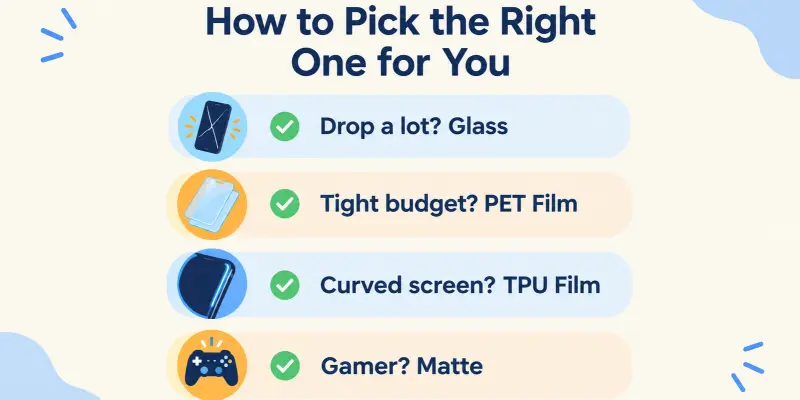
- You drop your phone a lot? Choose tempered glass.
- You want a very cheap fix? Choose PET film.
- You have a curved screen? Choose TPU film.
- You want a thin, clean look? Choose a liquid coat.
- You play games a lot? Choose a matte protector.
- You use your phone in public places? Choose a privacy protector.
- You use your phone in bright sunlight? Choose an anti-glare protector.
Which line sounds like you? Pick that type, then check the fit for your phone model.
How to Install a Screen Protector and When to Replace It
Installing a protector is easy. You just need a clean space and a little care.
How to Install
- Wash and dry your hands. This keeps fingerprints off the sticky side.
- Clean your screen. Use the wet wipe first. Then use the dry cloth.
- Remove dust. Press the dust sticker on the screen. It lifts specks.
- Line it up. Use the guide frame if you have one. Check the camera and speaker cutouts.
- Press from the center. Press the middle first. Then smooth outward to push out bubbles.
Quick tip: Work in a clean room. A steamy bathroom after a hot shower has less dust.
When to Replace It
Look for these signs:
- Cracks or deep scratches
- Peeling or lifting edges
- Bubbles that will not go away
- A cloudy or yellow look
- A slow or weak touch response
How often should you change it? Most people swap it every 6 to 12 months. Change it right away if it cracks.
Conclusion
A screen protector is a small cost that saves a big repair bill. Now you know the best types of screen protectors and how they differ. Want the best protection? Pick tempered glass. Want a low price? Pick PET film. Have a curved screen? Pick TPU film. Want a thin look? Pick a liquid coat. Ready to buy? Check your phone model first. Then pick the best protector for your needs. Your screen will thank you!
Faqs
Yes, they do. A protector blocks scratches and small bumps. Tempered glass also absorbs impact from drops. It cannot stop every break, but it lowers the risk.
They do different jobs. A case guards the back and corners. A protector guards the screen. Together, they give the best cover.
A good one does not. Thin, high-quality glass keeps touch smooth. Some phones scan your finger under the screen. For these, pick a protector made for in-screen sensors.
No. They differ in material, strength, clarity, and price. Glass protects more than basic film. Extras like privacy or matte also change how the screen looks.
It helps a little. But it often feels less smooth than glass. It may also block part of the screen. A separate protector gives you better feel and coverage.

- Be Respectful
- Stay Relevant
- Stay Positive
- True Feedback
- Encourage Discussion
- Avoid Spamming
- No Fake News
- Don't Copy-Paste
- No Personal Attacks
- Be Respectful
- Stay Relevant
- Stay Positive
- True Feedback
- Encourage Discussion
- Avoid Spamming
- No Fake News
- Don't Copy-Paste
- No Personal Attacks
