What Is a PSIM Phone? Meaning, SIM Card Types & eSIM vs PSIM
Published: 8 Mar 2026
A PSIM phone is a smartphone that uses a physical SIM card to connect to a mobile network. The PSIM simply refers to a physical SIM that you insert into your phone. This small SIM card stores your phone number and allows you to make calls, send texts, and use mobile data. Today, many modern phones also support eSIM, which works digitally without a physical card. In this guide, you will learn what is a PSIM phone, different SIM card types, and the key difference between PSIM and eSIM.
What Is a PSIM Phone?
A PSIM phone is a smartphone that uses a physical SIM card to connect to a mobile network. The PSIM meaning is Physical Subscriber Identity Module. If you are wondering What Is a PSIM Phone, it simply means a phone where you insert a SIM card to make calls, send texts, and use mobile data.
What Does PSIM Mean?
The PSIM meaning stands for Physical Subscriber Identity Module. It refers to the traditional SIM card that you insert into a phone.
Most regular smartphones are actually PSIM phones. The term mainly helps explain the difference between PSIM and newer eSIM technology.
What Is a Physical SIM Card?
A SIM card is a small chip that connects your phone to a mobile network. It stores your phone number and carrier information.
When you insert the SIM card into a phone, the device connects to the network. This lets you make calls, send messages, and use mobile internet.
How a SIM Card Works in a Phone
A SIM card is a small chip that helps your phone connect to a mobile network. When you insert the SIM card into the phone, the device reads the stored information and connects to the carrier. This is how calls, texts, and mobile data start working. In simple terms, What Is a PSIM Phone becomes clear because it uses a physical SIM card to make this connection.
Information Stored in a SIM Card
A SIM card stores important details needed for mobile service. Common information includes:
- Phone number – The number linked to your mobile account.
- Network authentication – Data that verifies your phone on the network.
- Contacts – Older phones could store contact numbers directly on the SIM card.
Types of SIM Cards
Over time, SIM cards have become smaller and more advanced. The main types include:
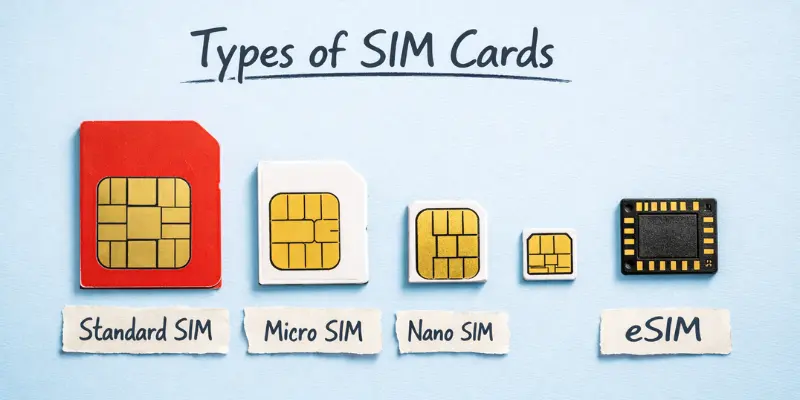
- Standard SIM – The largest SIM card used in older mobile phones.
- Micro SIM – Smaller than a standard SIM and used in early smartphones.
- Nano SIM – The smallest physical SIM card used in most modern phones.
- eSIM – A digital SIM built into the phone. You activate it without inserting a physical card.
PSIM vs eSIM: What Is the Difference?
Many people today compare esim vs psim to understand which SIM technology is better for modern smartphones. A PSIM is a physical SIM card that you insert into your phone. An eSIM, on the other hand, is an embedded SIM that works digitally without a physical card. Knowing the difference can help you choose the right phone and network setup.
What is an eSIM?
An eSIM (embedded SIM) is built into your phone. You don’t need a physical SIM card. Instead, you activate it digitally using your mobile carrier. It allows you to switch networks or add multiple phone numbers without replacing a SIM card. Many newer smartphones now support eSIM alongside PSIM.
eSIM vs PSIM Comparison
Here’s a simple comparison between eSIM vs. physical sim:
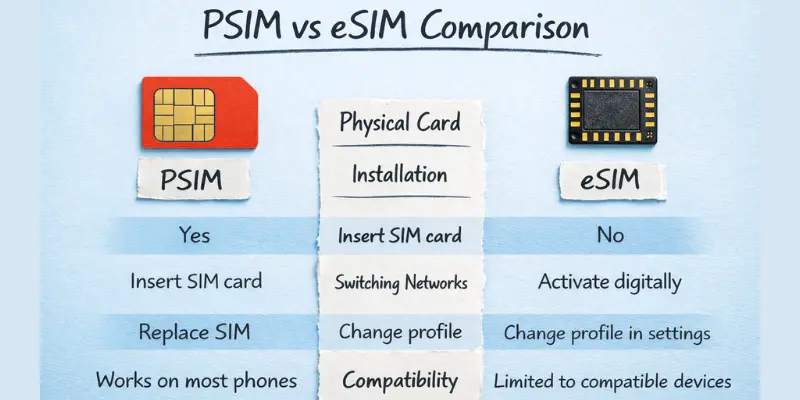
- Physical card – PSIM: Yes | eSIM: No
- Installation – PSIM: Insert SIM card | eSIM: Activate digitally
- Switching networks – PSIM: Replace SIM | eSIM: Change profile in settings
- Compatibility – PSIM: Works on most phones | eSIM: Limited to compatible devices
This highlights the key differences between PSIM and eSIM, helping you decide whether a physical SIM or an embedded SIM bestfits your needs.
Advantages and Disadvantages of PSIM Phones
Physical SIM cards (PSIM) are still widely used in smartphones today. They have several benefits that make them simple and practical. However, they also come with some drawbacks compared to modern eSIM technology. Here’s a clear look at both sides.
Advantages of PSIM Phones
Using a PSIM phone offers many practical benefits:
- Easy to swap SIM cards – You can move your SIM to another phone instantly.
- Works in most phones – Nearly all smartphones support PSIM.
- Better for travelers – You can easily use local SIM cards when abroad.
- No digital activation needed – Just insert the card, and it works.
- Simple troubleshooting – Physical SIMs are easy to remove and test.
- Multiple carrier options – You can change carriers by swapping SIMs.
Disadvantages of Physical SIM (PSIM)
Despite the benefits, PSIM has some downsides:
- Can be lost or damaged – Physical cards are small and fragile.
- Requires SIM tray – Phones must have a slot for the SIM card.
- Less secure than eSIM – Physical SIMs can be stolen or cloned.
- Manual switching – Changing networks requires physically replacing the SIM.
- Limited storage – Older SIMs only store a few contacts.
- Not future-proof – eSIM adoption is growing in modern smartphones.
Dual SIM and Multi SIM Phones Explained
Many modern smartphones now support multiple SIM cards. This allows users to manage personal and work numbers or use local SIMs while traveling. If you are wondering What Is a PSIM Phone, understanding dual SIM and 3 SIMs mobile devices shows how physical SIM cards are still useful today.
What Is a Dual SIM Phone?
A dual-SIM phone is a smartphone that can hold two SIM cards at the same time. This lets you use two phone numbers on one device. People often use one SIM for personal calls and the other for work, or one for local data while traveling abroad. Dual SIM phones are common and work with both PSIM and eSIM technologies.
- Manage personal and work numbers on one phone.
- Use local SIMs while traveling without changing devices.
- Supports both physical SIM (PSIM) and digital eSIM.
What Is a 3 SIMs Mobile?
A 3 SIMs mobile is a phone that can hold three SIM cards simultaneously. These phones are rare but exist in some markets. They are often used by business users or travelers who need multiple network connections. Having three SIM slots allows you to manage different carriers and phone numbers all on one device.
- Perfect for frequent travelers needing multiple carriers.
- Useful for businesses managing separate numbers.
- Rare but available in select markets for advanced SIM management.
PSIM Phone vs eSIM Phone: Which Is Better?
If you are wondering What Is a PSIM Phone and how it compares to an eSIM phone, the choice depends on your needs. Many people ask is esim better than physical sim? Travel, business use, security, and phone compatibility all play a role in deciding which is best.
- Travel users – PSIM phones are great for travelers who want to swap local SIM cards easily. eSIM phones let you switch networks digitally but may not be supported everywhere.
- Business users – eSIM phones are ideal for managing multiple numbers on one device without carrying extra SIM cards. PSIM phones need multiple slots for different numbers.
- Security – eSIM is more secure because it cannot be removed or stolen. PSIM cards can be lost, cloned, or damaged.
- Phone compatibility – PSIM works in almost all phones, while eSIM is limited to newer, compatible devices.
Overall, both have advantages. If you want convenience and security, eSIM may be better. If you need flexibility and universal support, PSIM is still very practical.
Phones That Use PSIM
Many smartphones still use a physical SIM, letting you insert a SIM card directly for calls, texts, and mobile data. These devices are convenient and widely compatible with networks around the world.
- Android phones – Most Android devices support a physical SIM setup.
- Samsung Galaxy phones – Many Galaxy models come with PSIM slots alongside eSIM in newer models.
- Google Pixel phones – Select Pixel phones support physical SIM cards.
- iPhones with physical SIM support – Older iPhones and some newer models allow using a physical SIM card.
All of these devices are examples of phones that answer the question What Is a PSIM Phone.
Can You Use PSIM and eSIM Together?
Yes, many modern smartphones allow you to use a physical SIM (PSIM) and an eSIM at the same time. This setup is called dual SIM, where one slot holds a PSIM and the other number works digitally through an eSIM. It’s useful for managing personal and work numbers or using a local SIM while traveling without removing your main SIM.
Example phones that support PSIM + eSIM:
- Apple iPhone – Many recent iPhones support one physical SIM and one eSIM.
- Google Pixel phones – Select Pixel models allow dual SIM with PSIM and eSIM.
- Samsung Galaxy phones – Some Galaxy models support one physical SIM and an eSIM for a second line.
This combination gives flexibility and convenience, letting you enjoy the benefits of both PSIM and eSIM on a single device.
How to Insert a SIM Card in a PSIM Phone
Inserting a SIM card in a PSIM phone is easy. Follow these simple steps:
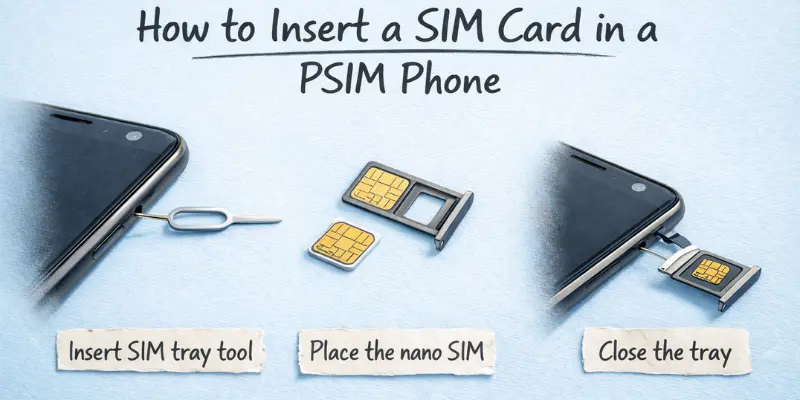
- Turn off your phone – Always power off before inserting a SIM card.
- Insert the SIM tray tool – Use the small pin that came with your phone to open the SIM tray.
- Place the nano SIM – Carefully put the SIM card into the tray with the gold contacts facing down.
- Turn the phone on – Close the tray and power on your phone. Your PSIM phone should now detect the SIM and connect to the network.
Future of SIM Technology
The future of SIM technology is shifting toward digital solutions. More phones are now adopting eSIM, which allows users to activate mobile service without a physical card. However, in some regions, people still prefer physical SIMs due to simplicity, availability, and ease of swapping between devices.
If you’re wondering What Is a PSIM Phone, it will continue to be relevant for users who rely on physical SIM cards, especially in areas where eSIM adoption is limited.
Conclusion
PSIM phones use physical SIM cards to connect to mobile networks, while eSIM offers a digital alternative without a physical card. Both technologies have their advantages, and they will continue to coexist for years as users choose between convenience, flexibility, and compatibility. If you are still learning What Is a PSIM Phone, this guide shows how it works, why it is still relevant, and how it compares to eSIM in modern smartphones. Understanding both options helps you pick the right device for your needs.
FAQs
A PSIM phone is a smartphone that uses a physical SIM card to connect to a mobile network. It allows you to make calls, send texts, and use mobile data by inserting a SIM card into the phone.
PSIM’s meaning is Physical Subscriber Identity Module. It refers to a traditional SIM card that stores your phone number and network details.
Yes, a PSIM is simply a physical SIM card. The term is used to differentiate it from an eSIM, which is embedded digitally in the phone.
It depends on your needs. eSIM is more secure, allows multiple profiles, and doesn’t require swapping cards. A physical SIM (PSIM) is easier to move between devices and works on almost all phones.
Yes, many modern smartphones support dual SIM, letting you use one PSIM and one eSIM at the same time. This is useful for work, travel, or managing multiple numbers.
A 3 SIMs mobile is a phone that can hold three SIM cards simultaneously. These phones are rare but useful for business users or travelers who need multiple networks on a single device.


- Be Respectful
- Stay Relevant
- Stay Positive
- True Feedback
- Encourage Discussion
- Avoid Spamming
- No Fake News
- Don't Copy-Paste
- No Personal Attacks
- Be Respectful
- Stay Relevant
- Stay Positive
- True Feedback
- Encourage Discussion
- Avoid Spamming
- No Fake News
- Don't Copy-Paste
- No Personal Attacks
