What is a dual carrier network in mobile?
Published: 19 Jan 2026
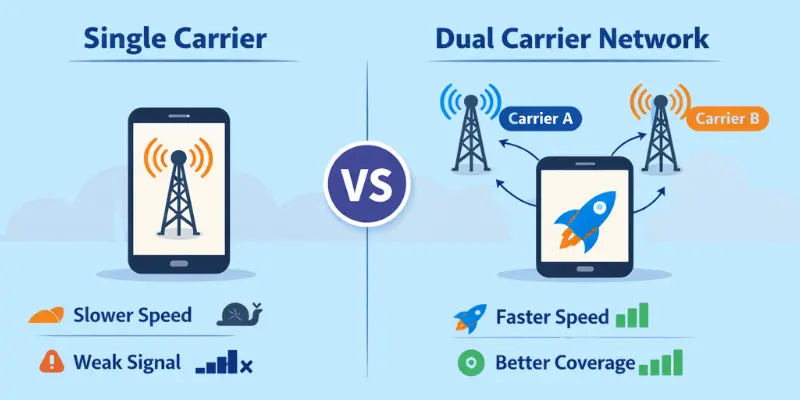
Have you ever wondered why your mobile data speeds or calls drop in certain areas? The answer could lie in your network setup. So, what is a dual-carrier network in mobile, and how can it help address these issues? A dual carrier network works by using two carrier networks simultaneously, improving your connection, offering faster speeds, and providing more reliable service—especially when one network alone can’t effectively cover the area.
What is Dual-SIM Technology?
Dual-SIM technology allows a mobile phone to use two SIM cards at the same time, meaning you can manage two phone numbers on a single device. This can be helpful in many situations, such as when you want to keep your work and personal numbers separate, or if you’re traveling internationally and need to switch between networks without changing SIM cards.
Think of it like having two phones in one—both numbers are active, so you can receive calls, send texts, and use data from both SIM cards without needing two separate devices. Many people who frequently travel or handle both business and personal calls simultaneously appreciate this setup.
How Does Dual-SIM Work in Different Phone Models?
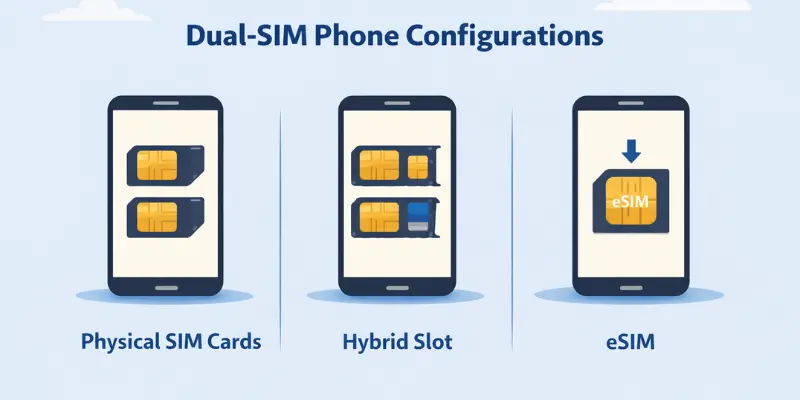
Dual-SIM technology works differently depending on the phone model and the SIM setup it supports. There are three main types of dual-SIM configurations: physical SIM cards, hybrid slots, and eSIM technology. Let’s break them down one by one:
1. Physical SIM Cards (Traditional Dual-SIM)
In the most basic dual-SIM setup, the phone has two physical SIM card slots. This means you insert two separate SIM cards—one for each network—into the phone. Both SIM cards are active at the same time, so you can receive calls and messages and use data from both networks.
This setup is straightforward and works well if you want two different phone numbers or need two network providers for better coverage.
How It Works:
- Step 1: Insert two physical SIM cards into the designated slots.
- Step 2: The phone recognizes both SIM cards, keeping both active for calls, messages, and data.
- Step 3: You can switch between networks or use them simultaneously for different services.
Pros:
- Simple and easy to use.
- You can easily swap SIM cards if needed.
Cons:
- The phone needs to have two physical slots, which can make it heavier.
- You need to carry extra SIM cards if traveling internationally.
Hybrid Slots (Dual-SIM + Extra Storage)
A hybrid SIM slot offers more flexibility. With this type of setup, your phone can use either two SIM cards or one SIM card and a microSD card (for extra storage). If you want a second SIM card, you can use it in place of the microSD card.
This setup is common in mid-range smartphones and gives you the choice between more storage or an extra SIM card.
How It Works:
- Step 1: Insert one SIM card and one microSD card, or two SIM cards (depending on your needs).
- Step 2: The phone recognizes the inserted SIM cards or one SIM and one SD card for storage.
- Step 3: Choose to switch between having a second SIM or extra storage at any time.
Pros:
- You have more flexibility to choose between an additional SIM card or more storage.
- It can save space on the phone’s design.
Cons:
- You can’t use both the second SIM and extra storage at the same time.
- Not all phones have hybrid slots.
eSIM Technology (The Modern Solution)
The latest and most advanced form of dual-SIM technology is eSIM (embedded SIM). Unlike traditional physical SIM cards, the eSIM is built directly into your phone’s hardware. You don’t need to insert or swap SIM cards at all! Instead, you can digitally activate a second mobile network on your device.
eSIM is a small chip embedded into the phone, making it a space-saver and a more seamless solution. You can easily switch carriers or activate different numbers without physically changing SIM cards.
How It Works:
- Step 1: The eSIM is pre-installed in the phone and doesn’t need a physical SIM card.
- Step 2: You can activate a second network by downloading a carrier profile to the eSIM.
- Step 3: Both networks are active on your phone, and you can switch between them as needed.
Pros:
- There is no need for a physical SIM card, which saves space and reduces the risk of SIM card damage.
- Switching between networks or carriers is easier, especially when traveling internationally.
- Phones with eSIMs are usually sleeker and more compact.
Cons:
- Not all carriers support eSIM yet.
- Setup can be more complex for some users, especially beginners.
Evolution of Dual-SIM Technology: From Physical SIMs to eSIMs
Dual-SIM technology has significantly advanced. In the past, dual-SIM phones relied on physical SIM cards, where users had to manually insert two separate SIM cards into the device. This system was fine for basic use but could be cumbersome, especially for travelers who needed to constantly swap SIM cards or carry extra phones.
As phone designs evolved, manufacturers introduced hybrid slots, allowing users to choose between an extra SIM card or a microSD card for storage. This brought more flexibility but still required a physical SIM card.
The most recent advancement is the eSIM technology, which eliminates the need for physical SIM cards altogether. With eSIMs, users can activate multiple networks digitally, allowing for more convenience and fewer physical parts. As more carriers adopt eSIM technology, it’s becoming the future of dual-SIM setups.
How Dual-SIM Technology Improves Connectivity and Work-Life Balance
Dual-SIM technology gives you more than just the ability to save money and be flexible. It greatly improves connectivity, makes managing mobile devices easier, and helps users keep a better work-life balance. Here are some more ways that dual-SIM can help you.
Better Mobile Coverage and Fewer Dropped Calls
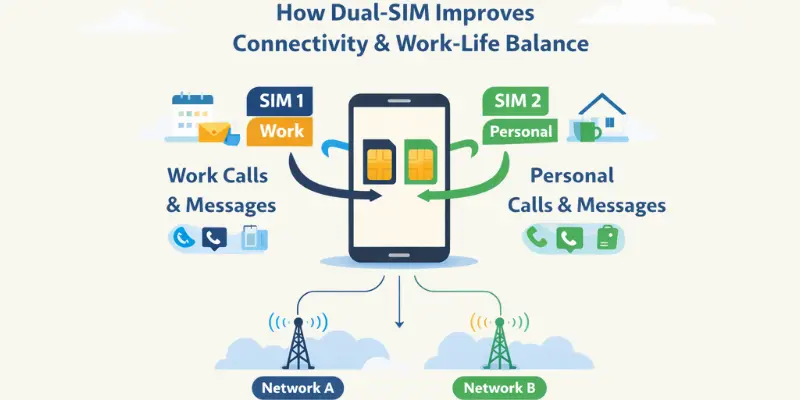
One of the biggest advantages of dual-SIM is improved coverage. With two networks to choose from, your phone can automatically switch to the one with the best signal, reducing dropped calls and slow data speeds, especially in areas with weak reception.
For example: A business traveler in a remote area can quickly switch to a network with better coverage so they don’t miss important calls or have trouble with slow internet while they’re on the go.
Save on Roaming Charges
Dual-SIM technology can save travelers a significant amount of money by avoiding high roaming charges. By using a local SIM for data and calls while keeping the home SIM active, you can stay connected without incurring expensive fees.
Example: A frequent traveler visiting several countries can easily insert a local SIM card for cheaper data and calls while still receiving important calls or messages on their home number, all without paying extra for roaming.
Switch Networks Easily Without Multiple Phones
With dual-SIM, you can switch between two networks with just one phone instead of having to use more than one. This means you don’t have to carry around two phones anymore, one for work and one for personal use. This makes life easier and more convenient.
Example: A digital nomad working from different cafes or remote locations can switch to the network with the best signal and data speeds, all within one phone, without the hassle of managing two separate devices.
Separate Work and Personal Calls
Dual-SIM allows you to keep work and personal calls separate by dedicating one SIM to each. This helps you stay organized and ensures that your work life doesn’t spill over into personal time. You can easily manage both numbers on one device, improving your work-life balance.
Example: A business professional can dedicate one SIM to work and the other to personal use. After hours, they can simply turn off the work SIM, knowing that they won’t be disturbed by work calls, allowing them to focus on personal time.
Real-World Benefits of Dual-SIM Technology
Dual-SIM technology is more than just flexible and cheap; it also offers real benefits for travelers, professionals, people who want to save money, and people who live all over the world. Let’s look at how this feature can make life easier and improve connectivity for different types of users.
For Travelers
Dual-SIM is a game-changer for travelers, as it allows them to use a local SIM for affordable data and keep their home number active, avoiding the high costs of roaming charges.
Example:
Imagine you’re traveling from the U.S. to Europe. With a dual-SIM phone, you can insert a local European SIM for cheaper data and use it for calls. Meanwhile, your U.S. number remains active on the second SIM, ensuring you don’t miss important calls without paying high roaming fees.
This setup combines the benefits of affordable local services with the accessibility of your home number.
For Professionals
Dual-SIM is an ideal solution for professionals who need to manage work and personal calls without juggling multiple phones. With two SIM cards, you can keep both aspects of your life organized and easily separate work from personal communication.
Example:
A business professional can dedicate one SIM to work calls and the other to personal calls. This allows them to stay organized and focused during work hours, and after work, they can simply turn off their work SIM to enjoy personal time without being interrupted.
This flexibility is key to improving work-life balance, especially for those who don’t want the stress of managing multiple devices.
For Cost-Conscious Users
For those looking to save on mobile expenses, dual-SIM offers the flexibility to take advantage of cheaper rates from different providers for calls and data. You can use one SIM for affordable calls and the other for better data rates, making your mobile plan more cost-effective.
Example:
A user living in a city with high mobile data rates can choose a cheap data plan for one SIM and a cheaper calling plan for the other. By securing the best rates for both data and calls, they can optimize costs without relying on a single provider.
Dual-SIM technology allows you to mix and match services to suit your specific needs, saving you money in the long run.
For Global Users
Dual-SIM is especially valuable for global users who frequently travel or live between different countries. It allows you to manage multiple numbers on one phone, which is ideal for staying connected across borders without the hassle of swapping SIM cards.
Example:
If you frequently travel between the U.S. and Mexico, you can use a U.S. SIM for work and a Mexican SIM for local calls and data. This way, you get better coverage, avoid high roaming fees, and don’t need multiple phones to stay connected.
This flexibility helps you manage different regional numbers and stay connected no matter where you are.
The Future of Dual-SIM and eSIM Technology
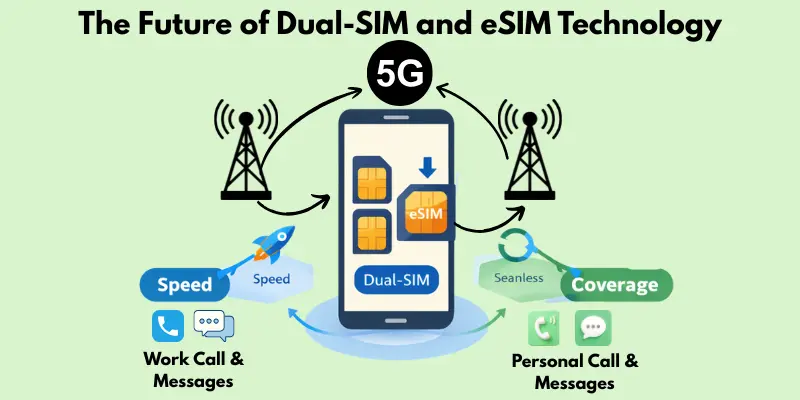
5G advancements, dual-carrier support, and the growing adoption of eSIM will shape the future of dual-SIM and eSIM technology. These innovations will significantly enhance the user experience by providing faster speeds, better coverage, and more seamless network switching. Here’s how these developments will impact the mobile world.
5G and Dual-SIM
With 5G networks rolling out globally, dual-SIM devices will benefit from significantly faster data speeds and more reliable connections. Whether in busy cities or remote locations, dual-SIM users will experience smoother internet and fewer network disruptions, thanks to 5G’s higher capacity and lower latency.
- Faster data speeds will enable seamless streaming, browsing, and app usage.
- 5G provides improved coverage in densely populated urban areas.
- 5G’s extended range enables more reliable connections in rural or remote areas.
Dual-Carrier Support
Dual-carrier support allows users to connect to two networks at once, which can drastically improve coverage and data speeds. In urban areas where networks can get congested, this feature ensures a stable connection. It also helps in rural areas by picking the most reliable network available.
- Dual-carrier support allows for stronger network connections.
- This allows for improved data speeds and smoother performance, even in crowded areas.
- In areas with limited network options, the signal strength improves, ensuring reliable communication.
eSIM: Seamless Switching Between Networks
With the rise of eSIM technology, users will no longer need physical SIM cards. eSIM makes it possible to switch between mobile carriers digitally, allowing for quicker setup and better flexibility. This feature is a major step forward for simplifying the dual-SIM experience.
- Instant network switching without needing to swap physical SIM cards.
- Global travelers can now activate multiple mobile plans remotely.
- The seamless integration allows users to quickly switch carriers or add a secondary line.
Impact on Device Design
As eSIM technology eliminates the need for a physical SIM card slot, smartphones will become thinner, lighter, and more efficient. Manufacturers will gain extra space to improve other features like battery life, camera quality, and waterproofing, making devices even more powerful and user-friendly.
- Phones will be thinner and lighter, providing a more compact design.
- More space will be available for battery improvements, which will result in longer usage times.
- Enhanced durability with fewer openings in the phone for better water resistance.
Debunking Common Myths About Dual-SIM Phones
Dual-SIM phones are becoming more popular, but there are still some myths that may make people hesitant to try them. Let’s address these myths and show how easy and practical dual-SIM technology can be.
Myth 1: “Dual-SIM Phones Are Harder to Use”
Many people think that dual-SIM phones are complicated or difficult to set up, but that’s simply not true. Most modern dual-SIM phones are designed to be user-friendly and easy to use.
- Simple setup: Once you insert the SIM cards, the phone will automatically detect them and offer an easy-to-follow setup process.
- Clear menus: Dual-SIM phones usually come with simple menus that let you manage both SIM cards without confusion. You can switch between networks, control data usage, and even choose which SIM to use for calls or messages—all with just a few taps.
With clear on-screen instructions and intuitive settings, managing two SIM cards is just as easy as using one.
Myth 2: “Dual-SIM Phones Have Shorter Battery Life”
It’s a common belief that dual-SIM phones drain the battery faster because they are connected to two networks at once. However, this isn’t necessarily true. Modern dual-SIM phones are designed to handle two networks efficiently.
- Battery management: Newer devices are built to optimize battery usage, ensuring that the phone manages power between the two SIM cards without causing unnecessary drain.
- Network prioritization: Dual-SIM phones intelligently prioritize one network for tasks like data and switch between networks only when necessary, helping save battery life.
While using two SIM cards might use slightly more battery than using one, the difference is minimal with modern models. You’ll still get a full day of use without worrying about constant charging.
Myth 3: “Dual-SIM Phones Are More Expensive”
Another misconception is that dual-SIM phones are always expensive. While some high-end models may be pricier, there are plenty of affordable options available.
- Affordable choices: Many budget-friendly phones, including popular brands like Xiaomi, Samsung, and Motorola, offer dual-SIM functionality at a reasonable price.
- Increased accessibility: With dual-SIM technology becoming more mainstream, dual-SIM phones are now available across a range of price points, making them accessible to more people.
You don’t have to spend a fortune to enjoy the benefits of dual-SIM technology, whether you’re looking for a budget phone or something with more advanced features.
Conclusion
So, we’ve explored everything about the dual carrier network—how it can improve your mobile connectivity, boost your data speeds, and help you stay connected in both urban and remote areas. We’ve also touched on how 5G and eSIM technology will make dual carrier networks even more efficient and user-friendly in the future.
If you’re someone who values fast, reliable connections and wants to get the most out of your mobile experience, I highly recommend looking into a dual carrier network setup. It’s a fantastic way to stay connected and ensure you get the best possible coverage, whether you’re at home or on the go.
Alright, folks, stay tuned! Keep learning and exploring, and you are welcome to reach out if you need any clarification. I’m always here to help you out!
FAQs
A dual carrier network allows a mobile device to use two different network bands simultaneously for faster data speeds and more reliable connections. It combines two channels to improve the internet experience. This is especially useful for users in areas with poor signal strength or high network traffic.
A dual carrier network improves speed by using two data channels at once, which effectively increases the available bandwidth. This means faster downloads, quicker browsing, and smoother streaming, especially when one network alone isn’t enough to handle high-speed data.
No, they’re related but not the same. Carrier aggregation refers to combining multiple frequency bands into one larger data channel, while dual-carrier aggregation specifically uses two distinct carriers or channels to increase data throughput. Both improve speed, but carrier aggregation tends to offer more significant speed boosts.
Yes, it can improve network coverage. When one carrier’s signal is weak or congested, the dual carrier network switches to the second carrier, helping ensure a more stable and reliable connection. This is especially useful in areas with inconsistent coverage.
Not necessarily. Modern smartphones are designed to support dual-carrier technology efficiently without significantly impacting battery life. While using two carriers at once might consume a bit more power, newer models manage energy well enough that you won’t notice a major difference in battery performance.

- Be Respectful
- Stay Relevant
- Stay Positive
- True Feedback
- Encourage Discussion
- Avoid Spamming
- No Fake News
- Don't Copy-Paste
- No Personal Attacks
- Be Respectful
- Stay Relevant
- Stay Positive
- True Feedback
- Encourage Discussion
- Avoid Spamming
- No Fake News
- Don't Copy-Paste
- No Personal Attacks
