Phone IP Rating Explained – Complete Guide for Buyers
Published: 11 Sep 2026
Have you ever dropped your phone in water or used it in heavy rain and felt worried? This is where a phone IP rating becomes important. A phone IP rating tells you how well it is protected from dust and water. Think about daily life, like walking in the rain, using your phone at the beach, or spilling water on the table. Will your phone survive in these situations? That depends on its protection level. After reading this guide, you will fully understand phone IP ratings and know which one is right for you.
What Is a Phone IP Rating?
A phone IP rating is a protection score that shows how safe your phone is from dust and water. IP stands for Ingress Protection, which means protection against things entering the device. The International Electrotechnical Commission sets the standards under the rule IEC 60529. This rule explains how companies test phones for dust and water resistance. Before buying a new phone, always check the phone’s IP rating so you know how strong and safe your device will be.
What Do the Numbers in Phone IP Ratings Mean?
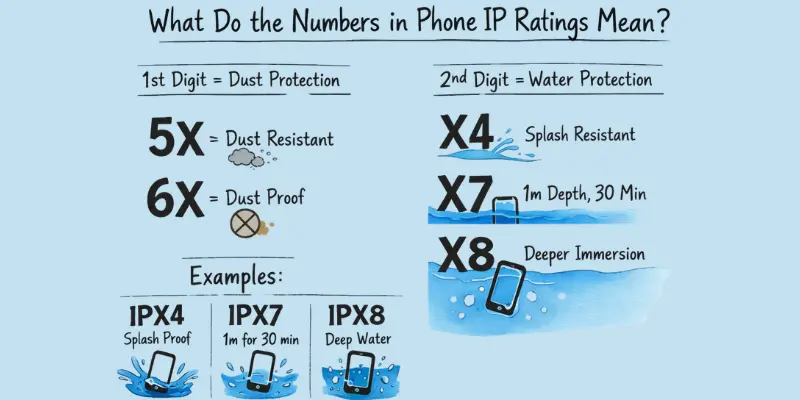
Phone IP ratings have two numbers. Each number has a clear meaning. The first digit shows dust protection. The second digit shows water protection. When you understand these numbers, you can choose the right phone with confidence.
First Digit – Dust Protection
The first number tells how well the phone blocks dust.
- IP5X means dust-resistant. Small dust may enter, but it will not harm the phone.
- IP6X means dust-proof. No dust can enter inside.
Dust-resistant means the phone can handle some dust. Dust-proof means full protection from dust. If you often visit dusty places, this number is very important.
Second Digit – Water Protection
The second number shows the water protection level.
- IPX4 means splash-resistant. It can handle water splashes from any direction.
- IPX7 means temporary immersion. The phone can stay in water up to 1 meter for about 30 minutes.
- IPX8 means continuous immersion. It can survive in deeper water for a longer time, based on company testing.
Always check both numbers before buying. Do you need basic splash safety or stronger water protection? Choose wisely.
How Are IP Ratings Tested?
Ever wonder how companies decide a phone’s IP rating? It’s not a guess. Every rating comes from strict lab testing.
The Testing Standard
All IP ratings follow one global rule called IEC 60529. This rule sets clear steps for testing dust and water protection. Every phone brand must follow the same process.
How Dust Testing Works
Labs place the phone inside a sealed chamber filled with fine dust. Machines blow the dust around for hours. After the test, engineers open the phone and check for dust inside.
How Water Testing Works
Water testing is more detailed. Labs use still, calm water—not moving water like a pool or ocean. The phone stays in this water at a fixed depth for a set time. For example, IP67 testing means 1 meter of water for 30 minutes.
Tip: Real-world water (waves, pressure, chemicals) is different from lab water. This is why your phone may not survive the same way in the ocean or a swimming pool.
Why Lab Conditions Matter
Salt water, chlorine, and hot water are not part of standard testing. These can weaken the phone’s seals faster than plain fresh water. That’s why brands often warn against swimming or diving with your phone, even with a high IP rating.
Tip: Always treat your IP rating as a lab result, not a real-world guarantee.
IP67 vs IP68 vs IP69 – What’s the Difference?
These ratings show different protection levels in phone IP ratings. Let’s compare them in simple bullet points so you can understand quickly.
IP67 – Water and Dust Resistance
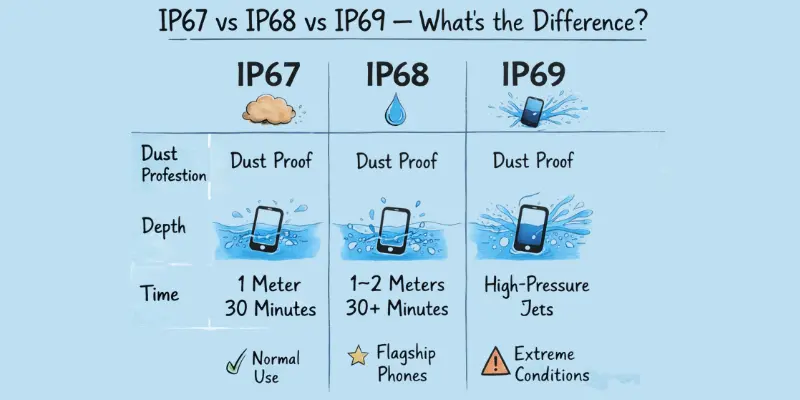
- Fully dust-proof. No dust can enter inside.
- Water protection up to 1 meter for 30 minutes.
- Good for rain, spills, and small accidents.
- Best for normal daily use.
IP68 – Water Resistance Rating
- Fully dust-proof like IP67.
- Better water protection than IP67.
- Can survive deeper water for a longer time.
- Common in flagship smartphones.
IP69 – High-Pressure Water Jets
- Fully dust-proof.
- Protects against high-pressure and hot water jets.
- Designed for extreme conditions.
- Mostly used in industrial devices.
Which One Is Best?
For most people, IP68 is the best choice. It gives strong protection without going extreme.
What Is the Highest IP Rating for Phones?
IP69 is the highest rating. But very few smartphones use it. Most premium phones stop at IP68 because it is already very powerful protection.
Is IP68 Waterproof? Or Just Water Resistant?
Many people ask, “Is my phone fully waterproof?” The honest answer is no. Most smartphones are water-resistant, not waterproof. A phone’s IP rating shows the protection level, but it does not mean lifetime safety in water.
Are Phones Waterproof?
No phone is truly waterproof. Waterproof means water can never enter inside. Smartphones are only tested for a limited time and depth. Protection can also degrade over time.
Waterproof vs Water Resistant Phone
Water-resistant means the phone can handle water for a short time. Waterproof means full protection in all water conditions. Most brands use the word water-resistant because it is more accurate.
Is Any Phone Truly Waterproof?
No mainstream smartphone is 100% waterproof. Even phones with IP68 have limits. If water damage happens after deep or long exposure, the warranty may not cover it.
How Waterproof Is IP68? Is It Good Enough?
IP68 is strong protection. It can survive deeper water for a longer time, based on company testing. For rain, splashes, and small drops, it is more than enough. But swimming with your phone is still risky.
So always remember, even a high rating does not mean unlimited water safety.
IP Rating vs ATM Rating (5ATM, 10ATM) – What’s Better?
When comparing water and dust protection, a phone IP rating helps you understand how safe your device is. Some people also see ATM ratings, mostly used for watches, but they indicate depth-based water protection. Here’s a simple guide.
5ATM Water Resistant Meaning
- 5ATM means the device can survive water up to 50 meters deep.
- Good for swimming in a pool or shallow water.
- Protects against splashes, rain, and short swimming sessions.
10ATM Water Rating
- 10ATM means water resistance up to 100 meters.
- Can handle deeper swimming, snorkeling, or water sports.
- Rare in phones, more common in smartwatches.
5ATM vs IP68
- IP68 is tested for dust and water, usually immersion in 1–2 meters for 30–60 minutes.
- 5ATM gives better depth-based water protection, ideal for swimming.
- Dust protection may be less clear in ATM ratings.
Which One Is Better for Swimming?
- For casual swimming, 5ATM is more reliable than IP68.
- For everyday use—rain, spills, splashes—IP68 is enough.
- Choose based on your lifestyle: swimming adventures or daily safety.
Phone IP Rating Chart
Here’s a simple phone IP rating chart to help you quickly check dust and water protection levels. This makes it easy to understand what each rating means at a glance.
| IP Rating | Dust & Water Protection |
| IP53 | Limited dust, light spray |
| IP54 | Splash-proof, basic protection |
| IP67 | Dust-tight, 1m water for 30 mins |
| IP68 | Dust-tight, deeper water |
Use this chart before buying a new phone. It shows which devices can handle rain, spills, or accidental drops in water.
How to Check Your Phone IP Rating
Not sure how protected your phone is? Here are easy ways to check it.
- Check the official website: Visit the phone brand’s official site. Look for the specifications section. Most brands list IP ratings clearly.
- Check the product box: Some phones include the IP rating on the box or in the included manual.
- Check the manufacturer page: Brands like Apple, Samsung, and Google have detailed product pages. For example:
- Google search format: Type your phone name + “IP rating” (e.g., iPhone 15 IP rating). You will find accurate results quickly.
These steps make it simple to verify your phone’s dust and water protection before buying or using it in risky situations.
What Happens If You Ignore Phone IP Ratings
Ignoring this protection level can cause serious problems.
- Water damage: Even small spills or rain can ruin the screen, battery, or internal parts.
- Dust inside speakers: Dust can block speakers, microphones, and ports, reducing sound quality.
- Warranty void issues: Many brands do not cover water or dust damage if the phone is misused.
Real-life example: Imagine taking a phone with no IP rating to the beach. Sand enters the ports, you drop it in shallow water, and suddenly it stops working. Repairs can be expensive, and your warranty might not help.
Always check the phone’s IP rating to avoid costly mistakes and protect your device.
What to Do If Your Phone Gets Wet Despite Its IP Rating
Even a strong IP rating doesn’t mean your phone is 100% safe. If water gets in, quick action can save your device.
Step 1: Remove It From Water Immediately
Don’t wait. The longer your phone stays wet, the higher the risk of damage.
Step 2: Turn Off the Phone
Power it down right away. This stops electricity from flowing and lowers the risk of a short circuit.
Step 3: Dry the Outside
Use a soft, dry cloth. Gently wipe the screen, ports, and speakers. Don’t shake the phone hard, as this can push water deeper inside.
Step 4: Avoid Charging Right Away
Do not plug in your phone until it’s fully dry. Charging a wet phone can cause serious damage.
Step 5: Let It Air Dry
Place your phone in a dry, room-temperature area. Give it several hours, or even overnight, before turning it back on.
Tip: Skip the rice trick. Rice doesn’t pull out moisture well and can leave dust inside your phone. A dry, ventilated space works better.
When to See a Professional
If your phone doesn’t turn on or acts strange after drying, take it to a repair center. Water damage isn’t always visible right away.
Phones With Highest IP Rating
Here are the top phones with strong protection levels that keep them safe from dust and water.
Smartphones With IP68
- Many flagship phones now come with IP68 protection.
- This means they are dust-tight and can survive deeper water for longer.
- Brands like Apple, Samsung, and Google use IP68 in their latest models.
Phones With IP Rating Comparison
- IP53–IP54: Basic splash and dust protection. Good for light use.
- IP67: Strong everyday protection. Good for rain and small water dips.
- IP68: Higher water resistance. Best for most users.
- IP69: Rare in phones, stronger against high-pressure water.
Phone With Highest IP Rating Currently
At the moment, most premium phones use IP68. Some rugged phones may even go beyond with extra water resistance. These models are best for outdoor use and adventure.
Are Budget Phones IP Rated?
Some budget phones do have an IP rating, but not all. Many mid-range models lack certified water resistance. If protection is important to you, check the rating before buying.
This section helps you see which phones have strong protection and which ones may need extra care.
Common Myths About Phone IP Ratings
Many people misunderstand this protection system. Let’s clear up some common myths:
- IP68 means swimming safe – Not always – IP68 protects against water for a limited time and depth, but it is not guaranteed for swimming.
- Waterproof forever – False – No phone stays waterproof forever. Seals can weaken over time.
- All Android phones are waterproof – Incorrect – Not all Android phones have water resistance. Some have no IP rating at all.
- IP rating never decreases – Misleading – Protection can be reduced if the phone gets damaged or ages.
Knowing the truth helps you use your phone safely and avoid accidental damage.
Final Verdict – What Is the Best Phone IP Rating for You?
Choosing the right protection level depends on how you use your device.
- Casual users: If you mostly stay indoors or avoid water, IP53 or IP54 is enough for light protection against splashes and dust.
- Outdoor users: If you hike, travel, or spend time outside, IP67 or IP68 is better. It protects against rain, dust, and accidental drops in water.
- Beach/rain exposure: For frequent exposure to sand, water, or heavy rain, IP68 is ideal. It keeps your phone safe in tougher conditions.
For most normal users, IP68 is the best choice. It offers strong dust and water protection without needing extreme measures, keeping your phone safe in everyday life.
Conclusion
Understanding your phone’s IP rating helps you choose a device that fits your lifestyle. From casual use to outdoor adventures, knowing the protection level can save your phone from water and dust damage. Always check the IP rating before buying, and handle your device carefully to keep it safe. With the right rating, you can enjoy your phone worry-free in any situation.
FAQs
The highest IP rating for most smartphones is IP68. Some rugged phones may go higher, like IP69, but IP68 is enough for daily use and strong water protection.
No, IP68 phones are water-resistant, not fully waterproof. They can survive water for a limited depth and time, but swimming or long immersion can still cause damage.
IP54 means the phone has limited dust protection and is splash-resistant. It can handle rain and small spills, but should not be submerged in water.
It is not recommended. IP67 protects against temporary water immersion up to 1 meter for 30 minutes, but hot water, soap, or pressure in a shower may damage the phone.
IPX8 usually allows longer or deeper water immersion than IP68. Both provide strong water protection, but IPX8 is tested for continuous water exposure.
No phone is truly waterproof. Ratings like IP67 and IP68 mean water-resistant under tested conditions, but always avoid long or deep water exposure.



- Be Respectful
- Stay Relevant
- Stay Positive
- True Feedback
- Encourage Discussion
- Avoid Spamming
- No Fake News
- Don't Copy-Paste
- No Personal Attacks
- Be Respectful
- Stay Relevant
- Stay Positive
- True Feedback
- Encourage Discussion
- Avoid Spamming
- No Fake News
- Don't Copy-Paste
- No Personal Attacks
