Gorilla Glass vs Tempered Glass: Which One Protects Your Phone Better?
Published: 7 Oct 2026
Nobody wants a cracked or scratched phone screen. Then the shopkeeper asks if you want a tempered glass protector, and your phone already says “Gorilla Glass” on the box. Now you feel unsure. Do you need both? This Gorilla Glass vs tempered glass guide helps you decide without wasting money.
What Is Gorilla Glass?
Gorilla Glass is a tough glass made by Corning. It first appeared in 2007. Today, many phone makers use it for their screens.
How do makers produce it? They dip the glass in a hot bath of potassium salt. Bigger potassium ions replace smaller sodium ions on the surface. Experts call this ion exchange.
Think of a crowded bus. Every seat is full, and nobody can move easily. The glass surface works the same way. The tight space stops cracks from spreading.
Where do you find Gorilla Glass?
- Smartphones
- Tablets
- Laptops
- Smartwatches and other wearables
Here is a real-life example. Many people keep their keys and phone in the same pocket. Keys can scratch a screen. Gorilla Glass helps the screen handle this daily rubbing. It is not scratch-proof, though.
Does your phone use it? Check the phone’s spec page to find out.
What Is Tempered Glass?
Tempered glass is a type of glass. It is not a brand. Many companies make it, and you see it in many places.
Makers use two main methods to make it:
- Heat tempering: Workers heat the glass to a very high temperature. Then they cool it quickly. The outside cools first and gets hard, and the inside stays hot a little longer. This builds a strong stress inside the glass.
- Chemical tempering: Makers soak the glass in a salt bath. Bigger ions replace smaller ones on the surface. This is the same ion exchange you read about earlier. Gorilla Glass is made this way.
So Gorilla Glass is also a kind of tempered glass. Surprised?
Where do you find tempered glass?
- Phone screen protectors
- Car side windows
- Shower doors
Here is a real-life example. Imagine a shower door breaks by accident. Normal glass would break into long, sharp pieces. Tempered glass breaks into small, blunt pieces. These pieces are less likely to cut you.
Gorilla Glass vs Tempered Glass: Key Differences
Both glasses are strong. But they do different jobs. Here is a quick look.
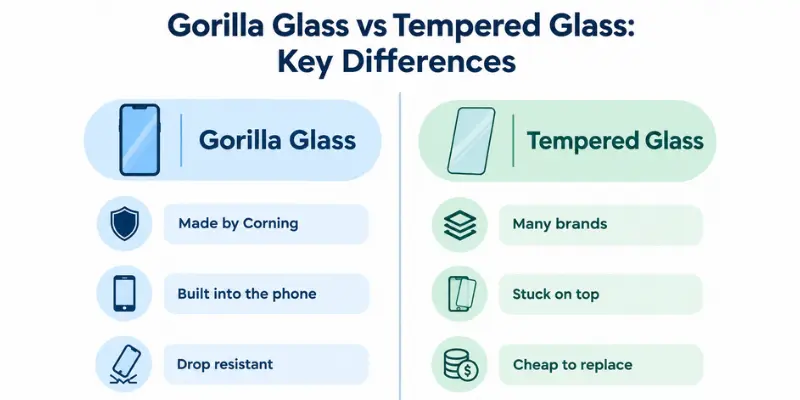
| Gorilla Glass | Tempered Glass | |
| Type | A brand of strengthened glass | A category of strengthened glass |
| Made by | Corning | Many companies |
| Process | Chemical (ion exchange) | Heat or chemical |
| Thickness | Thin, built into the phone | Adds an extra layer on top |
| Scratch resistance | Good, but not scratch-proof | Depends on quality |
| Drop resistance | Made to survive drops | Takes the hit and may crack |
| Price | Part of the phone price | Low cost to replace |
| Best use | The phone’s main screen | An extra protector |
Strength
Gorilla Glass forms the phone’s own screen. Corning designs it to handle drops. A tempered glass protector works as a shield. It takes the hit first. If it cracks, you replace it and keep your screen safe.
Scratch Resistance
Both resist everyday scratches. Neither is scratch-proof. Sand and hard objects can still leave marks.
Have you seen “9H” on a protector box? It is a hardness rating. It indicates how well the surface resists scratches. It does not tell you how well the glass survives a drop. A 9H protector can still crack if you drop your phone.
Thickness and Touch Feel
Gorilla Glass is part of the screen. You feel nothing extra. A protector adds a thin layer. A thick, cheap one can feel less smooth when you swipe.
Clarity
Gorilla Glass keeps the screen clear. A good protector also looks clear. A poor one can look dull or show fingerprints more.
Price (Gorilla Glass Rate)
You cannot buy Gorilla Glass alone for a phone. Its cost is already in the phone price. Tempered glass protectors are cheap and easy to find.
Gorilla Glass 3 vs Gorilla Glass 6
Corning makes many versions of Gorilla Glass. Each new version fixes a weak point of the old one. Let’s compare Gorilla Glass 3 and Gorilla Glass 6.
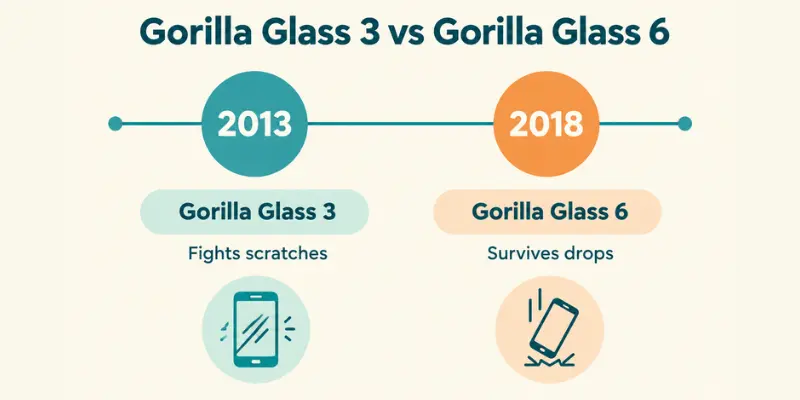
Gorilla Glass 3 came out in 2013. Corning built it to fight scratches. The company said it was 3 times more scratch-resistant than Gorilla Glass 2. It also showed 40% fewer visible scratches.
Gorilla Glass 6 came out in 2018. Corning built it for drops. In lab tests, it survived 15 drops from 1 meter onto rough surfaces. Corning says it is up to 2 times better than Gorilla Glass 5.
| Gorilla Glass 3 | Gorilla Glass 6 | |
| Year | 2013 | 2018 |
| Main focus | Scratch resistance | Multiple drops |
| Corning’s claim | 3x better scratch resistance than Gorilla Glass 2 | 15 drops from 1 meter (lab average) |
| Found in | Galaxy S4 | Galaxy S10 |
Which One Is Better?
Gorilla Glass 6 wins for drops. It is also newer. Most people drop their phones more often than they scratch them badly. So Gorilla Glass 6 suits daily life better.
One note: Corning tested each glass against a different older version. So the numbers do not compare directly.
Newer Versions
Corning keeps improving. Gorilla Glass Victus, Victus 2, and Gorilla Armor are newer options.
How to Check Your Phone’s Glass
Want to know which glass you have? Follow these steps:
- Search for your phone model on the manufacturer’s website.
- Open the “Specs” or “display” section.
- Look for “Gorilla Glass” and its version name.
Do You Need a Screen Protector on Gorilla Glass?
Gorilla Glass is tough. But it is not perfect. It handles drops well. Still, sharp objects and hard falls can scratch or chip it. Is a protector worth it?
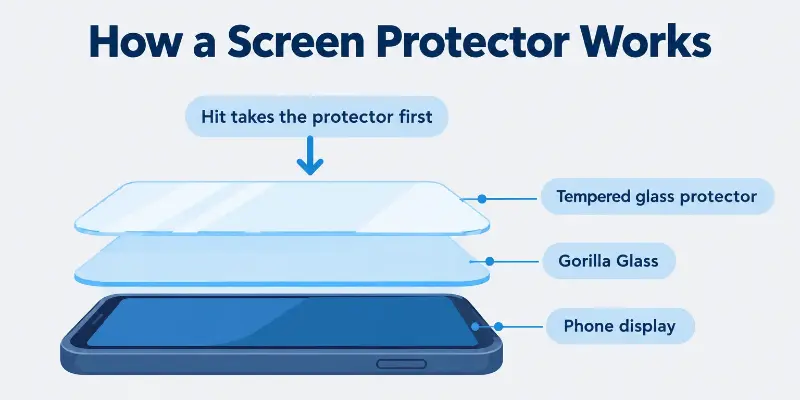
A tempered glass protector works like a shield. It takes the hit first. If it cracks, your phone’s screen stays safe. Then you replace the cheap protector, not the costly screen.
When to Use a Protector
- You drop your phone often.
- You keep keys or coins in the same pocket.
- You work outside or on a building site.
- You plan to sell your phone later.
When You Can Skip It
- You use a case and handle your phone with care.
- You dislike the feel of an extra layer.
How to Choose a Good Protector
Follow these tips:
- Check the thickness. A thin protector feels smoother. A thick one gives more cushion but feels bulky.
- Look for an oleophobic coating. This coating fights fingerprints and smudges. Your screen stays clean.
- Check the fit. The protector should match your phone model. Camera and speaker cutouts must line up.
- Pick a case-friendly size. Some protectors lift at the edges when you add a case.
Would you rather spend a little now or a lot later? For most people, a protector is cheap peace of mind.
Which One Should You Choose?
The right choice depends on you. Find your type below.
Pick Your Match
- Budget user: Buy a tempered glass protector. It costs little, and it shields your screen.
- Heavy user: Choose a phone with Gorilla Glass and add a protector. You get two layers of defense. This suits people who drop their phones often.
- Manufacturer or custom glass buyer: Choose Gorilla Glass sheets. Device makers use them as cover glass. Ask a glass supplier about sizes and options.
Not sure which one fits you? Start with your phone. If it already has Gorilla Glass, a protector is a cheap extra.
Common Myths
- Myth: Gorilla Glass is scratch-proof.
Fact: It resists scratches, but hard objects can still mark it. - Myth: A 9H protector will not crack in a drop.
Fact: 9H measures scratch hardness, not drop safety. - Myth: You must pick one or the other.
Fact: They do different jobs, and they work well together.
FAQs
No. It resists scratches, but it is not scratch-proof. Sand, hard stones, and sharp tools can still mark it.
It is not a simple “yes” or “no.” Gorilla Glass is itself a kind of tempered glass. Corning designed it for phone screens. A tempered glass protector has a different job. It takes the hit first so your screen stays safe.
Both are brands of strengthened glass for devices. Corning makes Gorilla Glass. Panda Glass is a rival brand. Check your phone’s spec page to see which one it uses.
Apple has worked with Corning since the first iphone. But Apple does not usually call it “Gorilla Glass.” Newer iPhones use a glass Apple calls Ceramic Shield, which Corning made.
Conclusion
The Gorilla Glass vs tempered glass question is simple once you know the roles. Gorilla Glass is the tough glass built into your phone. A tempered glass protector is the cheap shield you stick on top. They work best as a team.
Our advice is clear. If your phone has Gorilla Glass, add a good tempered glass protector. This is a small cost for strong protection. Your next step takes two minutes. Open your phone’s spec page and check which glass it uses. Then pick a protector that fits your model.
Ready to keep your screen safe?


- Be Respectful
- Stay Relevant
- Stay Positive
- True Feedback
- Encourage Discussion
- Avoid Spamming
- No Fake News
- Don't Copy-Paste
- No Personal Attacks
- Be Respectful
- Stay Relevant
- Stay Positive
- True Feedback
- Encourage Discussion
- Avoid Spamming
- No Fake News
- Don't Copy-Paste
- No Personal Attacks
