What is mobile phone spectrum: Complete Guide
Published: 8 Jan 2026
This guide is designed to break down what the mobile phone spectrum is, why it matters, and how it impacts your daily phone usage without going into more confusing technical terms. Whether you’re streaming your favorite show, making video calls, or just browsing social media, Spectrum is the key to a smooth, high-speed experience. The better the spectrum, the faster your data speeds, the clearer your calls, and the more reliable your connection. Let’s dive in and simplify it so you can better understand how Spectrum affects everything you do on your phone!
What is Mobile Phone Spectrum?
Mobile phone spectrum refers to a range of radio frequencies that mobile phones use to communicate with the network. It’s the invisible space that allows your phone to send and receive calls, texts, and data. Think of the mobile phone spectrum as a highway for signals between your phone and the network. Just like cars need lanes on a road to travel, your phone needs spectrum to connect with the network and exchange information. Without this spectrum, your phone wouldn’t be able to work.
What is Spectrum in Simple Terms?
Defining Spectrum
Spectrum is a part of the airwaves, or radio waves, that mobile phones use to send signals. Think of it like a special path or lane that allows your phone to communicate with the network. Without these radio waves, your phone wouldn’t be able to connect to anything!
Types of Spectrum
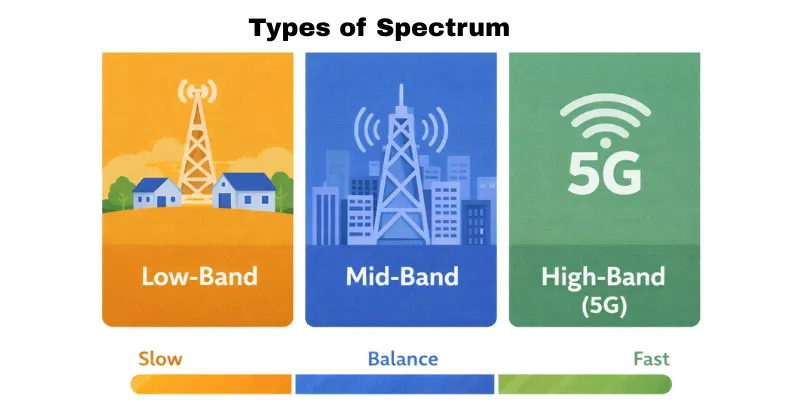
- Low-Band Spectrum: This spectrum covers a wide area, making it perfect for places like rural areas. It’s slower, but it helps your phone work even in faraway places.
- Mid-Band Spectrum: This spectrum is a favorable mix of coverage and speed. It’s ideal for cities where people require rapid connections and reliable coverage.
- High-Band Spectrum (5G): This spectrum offers super-fast speeds, but it only works well over short distances. It’s perfect for busy cities, but not for rural areas.
Example: Low-band spectrum helps you make calls in rural areas, while mid-band is ideal for cities.
How Mobile Phones Use Spectrum
How Phones Connect to Networks
Mobile phones connect to mobile networks by using specific frequency bands in the spectrum. These bands act like lanes on a highway, allowing signals from your phone to travel to nearby towers. When you make a call or use the internet, your phone selects a frequency band that matches the closest tower.
- Mobile phones rely on frequency bands to communicate with nearby towers.
- Each frequency band is optimized for different uses, such as voice calls or internet data.
- Phones automatically choose the best frequency band based on your location and network conditions.
- These frequency bands help ensure your phone maintains a strong signal connection.
Spectrum and 5G
5G networks use more spectrum compared to previous generations, like 4 G. By utilizing higher frequency bands, 5G can provide faster data speeds and handle more devices at the same time. This is why 5G is expected to revolutionize mobile internet, offering speeds that are much quicker than what we currently experience.
- 5G uses high-band spectrum to provide faster data speeds.
- It can support more devices simultaneously, making it ideal for crowded areas.
- The extra spectrum enables 5G to offer improved download speeds and reduced latency.
- 5G’s spectrum usage helps improve the overall user experience, especially in busy environments.
How is Spectrum managed?
Who Owns the Spectrum?
The spectrum is owned and regulated by governments worldwide. Governments manage the airwaves to ensure mobile networks don’t overlap or interfere with each other. They decide how to divide the spectrum into different frequency bands and who can use them.
- Governments control the spectrum to avoid signal interference.
- They assign specific frequency bands to different uses, such as mobile networks or radio stations.
- Regulatory bodies, such as the FCC in the U.S., oversee the allocation of the spectrum.
- Governments help ensure fair use, preventing one company from taking all the spectrum.
Spectrum Auctions
At auctions, companies that offer phone service bid on spectrum licenses. Through these auctions, businesses can buy the rights to use some parts of the spectrum. The goal is to improve services, like making them faster and covering more area. Governments sell spectrum at auction every few years to keep up with demand.
- Telecom companies compete in auctions to get the best spectrum bands.
- The companies that win the auctions can offer improved network services.
- Auctions help ensure that the spectrum is used efficiently and fairly.
- The winning companies pay large amounts for the right to use the spectrum.
The Impact of Mobile Spectrum on Users
Better Coverage and Faster Speeds
When telecom companies have access to more spectrum, they can improve their mobile services. More spectrum allows companies to expand coverage and offer faster data speeds. This means your phone will work better, even in crowded or remote areas.
- More spectrum helps telecom companies provide better signal strength.
- With more spectrum, companies can handle more users at once without slowdowns.
- Faster internet speeds allow for smoother browsing, video streaming, and gaming.
- Better coverage means fewer dropped calls, even in places where the signal is weak.
Spectrum and the 5G Rollout
Spectrum availability significantly influences the speed of 5G deployment. The more spectrum telecom companies can secure, the faster and better they can provide 5G services to their customers. Without enough spectrum, 5G speeds may not reach their full potential, and coverage could be limited.
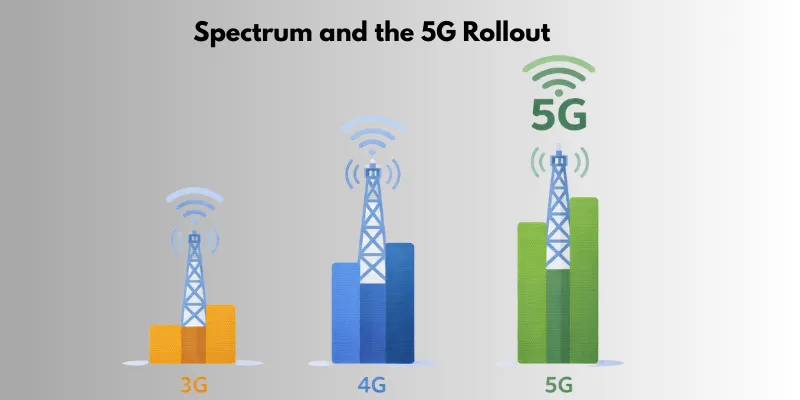
- More spectrum speeds up the rollout of 5G technology.
- Without enough spectrum, 5G service may be slower and have limited coverage.
- Telecom companies need to secure high-band spectrum for ultra-fast 5G speeds.
- The spread of 5G depends on how much spectrum is available for use in each area.
Challenges with Mobile Spectrum
Limited Availability
Mobile spectrum is a limited resource, meaning there is only so much space available for all the devices that need to use it. Phones, tablets, and other devices aren’t the only ones using the spectrum. Other services like TV and radio also rely on these frequencies. As more devices use the spectrum, it becomes harder to keep up with the growing demand.
- The spectrum is a fixed resource, so not everyone can have access to it at once.
- More devices using the same spectrum can lead to signal interference and weaker connections.
- Governments must carefully manage and allocate the available spectrum.
- Spectrum is shared across many industries, making it more challenging to meet demand.
Spectrum Congestion
Overload on the network can result in slower speeds and poor service as the number of users and connected devices increases. This phenomenon is especially true in populous areas where many people are using their phones at the same time. The more devices on the same network, the more likely the service will slow down.
- More users on the network can overload the available spectrum.
- In densely populated areas, many devices can compete for the same bandwidth, leading to slower speeds.
- Major events, like concerts or sports games, can cause network congestion because so many people are using their phones at once.
- Telecom companies work to manage congestion, but it’s a challenge when there’s limited spectrum available.
What Does the Future Hold for Mobile Spectrum?
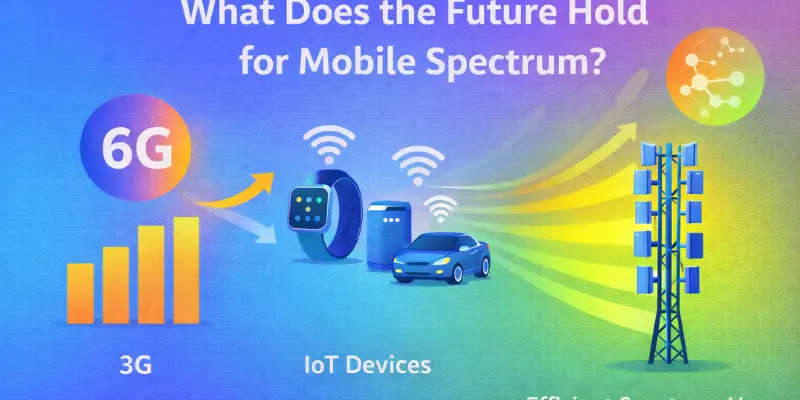
The future of mobile spectrum is moving toward faster, smarter, and more efficient connectivity.
Technologies like 6G, smart antennas, and IoT will help use spectrum more efficiently while improving speed and coverage.
The Role of 5G and Beyond
5G technology is just the beginning of the future of mobile spectrum. To achieve the ultra-fast speeds and low latency promised by 5G, telecom companies need more spectrum, especially in high-band frequencies. As technology continues to evolve, future innovations like 6G will require even more spectrum to support a growing number of connected devices.
- 5G already uses more spectrum than previous technologies, but future technologies will need even more.
- The increasing number of connected devices, such as smart homes and IoT gadgets, will require more spectrum to ensure smooth performance.
- 6G and other future networks will need high-frequency bands to support faster speeds and larger networks.
- As new technologies emerge, spectrum will be crucial in providing high-quality, reliable service.
Improving Spectrum Efficiency
As the demand for spectrum increases, technology is working to make the most of the available space. New advancements, like dynamic spectrum sharing, allow telecom companies to use the same frequencies for different networks at different times. This makes it possible to handle more devices and data without needing more spectrum.
- New technologies are enabling the more efficient sharing of spectrum between different networks and devices.
- Advanced techniques, like using smart antennas and software, help maximize the use of available spectrum.
- Innovations such as spectrum refarming enable the repurposing of old frequency bands for new technologies like 5G.
- Improved efficiency helps telecom companies support more users and offer faster speeds without needing to buy more spectrum.
Tips for a Better Mobile Experience
- Use Wi-Fi when possible: By connecting to Wi-Fi, you reduce the strain on mobile networks and avoid using up valuable spectrum. This can help improve your phone’s performance and save on data usage.
- Check for 5G coverage in your area: 5G offers faster speeds and better performance. Make sure your location has 5G coverage so you can enjoy the benefits of high-speed internet on your phone.
- Upgrade your phone: To fully take advantage of new spectrum technologies like 5G, ensure your phone supports the latest networks. Newer models are built to handle faster speeds and more efficient spectrum use.
Conclusion
So guys, in this article, we’ve covered the mobile phone spectrum in detail. Understanding how spectrum works is key to knowing why your phone’s performance can vary in different areas. My recommendation is to always check for 5G coverage in your area and make sure your phone is up to date to enjoy faster speeds. Stay connected and make the most out of your mobile experience! If you found this helpful, don’t forget to share it with friends who might need a little more insight into how their phones connect.
FAQs
Mobile phone spectrum is a part of the airwaves used by mobile devices to send and receive signals. It includes different frequency bands, each suited for specific types of communication. Without spectrum, your phone wouldn’t be able to make calls, send texts, or access the internet.
Your phone can connect to the network because of the mobile phone spectrum. It tells you how strong your signal is, how fast your data is, and how far it goes. Your phone works better when there is more spectrum available.
Mobile phones connect to networks using specific frequency bands in the mobile spectrum. These bands help your phone send signals to nearby towers. Your phone automatically chooses the best frequency band depending on your location.
5G is the fifth generation of mobile network technology, offering faster speeds and more reliable connections. It uses more spectrum than previous generations, particularly in high-band frequencies. 5G allows for faster downloads and lower latency, making the internet experience smoother.
The amount and type of spectrum available affect how well your phone works. If there’s limited spectrum, your phone might experience slower speeds or poor coverage, especially in busy areas. More spectrum means faster data and more reliable connections.
Spectrum overload happens when too many devices are using the same part of the spectrum, causing the network to slow down. This often happens during busy times, like at a concert or in crowded areas. It’s like too many cars on the road, causing traffic jams.
The government holds auctions for mobile spectrum, which telecom companies can buy. They bid on certain frequency bands, and if they win, they can use them for their network services. These auctions monitor spectrum usage and ensure equitable opportunities for all participants.
Your phone may slow down at crowded events because many people are using the same part of the spectrum at once. When too many devices connect to the network, it can become congested. This leads to slower speeds and dropped connections.
Yes! Using Wi-Fi helps reduce the load on the mobile spectrum, which can improve your phone’s performance. It also saves your mobile data and ensures faster internet speeds, especially when you’re in a crowded area.
To obtain the best mobile service, check if 5G is available in your area and upgrade to a 5G-compatible phone. Furthermore, try to use Wi-Fi to ease the strain on your mobile network. Keeping your phone’s settings and network capabilities up to date ensures the best experience.

- Be Respectful
- Stay Relevant
- Stay Positive
- True Feedback
- Encourage Discussion
- Avoid Spamming
- No Fake News
- Don't Copy-Paste
- No Personal Attacks
- Be Respectful
- Stay Relevant
- Stay Positive
- True Feedback
- Encourage Discussion
- Avoid Spamming
- No Fake News
- Don't Copy-Paste
- No Personal Attacks
