POLED vs AMOLED: A Complete Guide
Published: 5 Feb 2026
When choosing a new smartphone, tablet, or any device with a screen, the display type can make a big difference in your overall experience. Two common types of screens you’ll come across are POLED and AMOLED. While both offer great picture quality, they work in slightly different ways, and understanding how can help you make a more informed decision. In this article, we’ll break down the differences between POLED vs AMOLED, so you can better understand which one is right for your next device.
What is OLED?
OLED stands for Organic Light Emitting Diode. It’s a display technology that uses organic compounds to create light when an electrical current passes through them. Unlike older screen technologies, OLED doesn’t require a backlight. Instead, each individual pixel lights up on its own, allowing for vibrant colours, deeper blacks, and more energy-efficient displays—perfect for smartphones.
How Does OLED Work?
OLED screens are made up of several layers, with organic materials placed between electrodes. When electricity flows through these electrodes, the organic materials light up, creating the images and colors you see. Since each pixel generates its own light, OLED screens can turn off individual pixels completely, producing true black and creating higher contrast between light and dark areas.
Why is OLED Important?
- Better Color Accuracy: OLED displays show colors more accurately, making images and videos appear more lifelike and vibrant.
- Improved Contrast: The ability to turn off individual pixels results in perfect blacks, offering stunning contrast between light and dark areas.
- Thinner Displays: Since OLED screens don’t require a backlight, they can be made much thinner, enabling sleeker, lighter devices and even flexible or curved screens.
- Energy Efficiency: OLED screens are more energy-efficient because only the lit pixels consume power. This means black pixels don’t consume any power, improving battery life.
The Impact of OLED on Modern Devices
You’ll find OLED technology in many modern devices, including smartphones, TVs, and smartwatches. It allows for stunning visuals with rich colors, deeper contrast, and sleeker designs. OLED displays also improve battery life, making them ideal for devices that need both performance and efficiency.
What is AMOLED Technology?
AMOLED stands for Active Matrix Organic Light Emitting Diode. It’s a type of OLED technology, but with one important difference: each pixel is controlled by its own individual transistor. This “active matrix” system allows each pixel to work independently, improving the display’s overall quality and performance.
How Does AMOLED Work?
In an AMOLED display, each pixel is controlled by its own transistor, thanks to the “active matrix” structure. This allows each pixel to work independently, improving display quality and responsiveness. It also helps reduce power consumption by turning off pixels that display dark or black images, making AMOLED more energy-efficient.
Why is AMOLED Technology Important?
AMOLED technology is known for several advantages:
- Better Display Quality: The individual control of each pixel allows for high contrast, sharper images, and more vibrant colors.
- Power Efficiency: AMOLED screens use less power because black pixels are completely turned off, which is especially useful for devices like smartphones that need to conserve battery life.
- Improved Responsiveness: Thanks to their active-matrix structure, AMOLED displays refresh faster, making them ideal for fast-moving media like video games and movies.
AMOLED in High-End Devices
AMOLED displays are used in many high-end devices, particularly in the Samsung Galaxy series, where the superior display quality is a key feature. These screens provide an immersive viewing experience, with vivid colors and deep blacks that make images pop.
AMOLED vs. POLED: What’s the Difference?
While both AMOLED and POLED are types of OLED technology, they have some differences:
- AMOLED: Uses an “active matrix” of transistors to control each pixel individually. This results in faster response times, better power efficiency, and higher-quality displays.
- POLED: Stands for Polymer Organic Light Emitting Diode and typically uses flexible organic materials, which makes POLED screens more suitable for curved or foldable displays. POLED screens may not have the same power efficiency and speed as AMOLED, but they excel in flexibility and design.
What is POLED Technology?
POLED stands for Plastic Organic Light Emitting Diode. It’s a flexible OLED display that uses plastic rather than glass as its substrate, making it lighter, more durable, and more resistant to damage.
How Does POLED Work?
POLED uses organic materials that emit light when powered. The plastic substrate makes the screen flexible, allowing it to bend and fold without breaking. This flexibility opens up design possibilities, such as curved and foldable screens.
POLED vs. Other OLED Technologies
- Flexibility: POLED screens are bendable, unlike glass OLED screens.
- Durability: POLED is lighter and more resistant to damage from drops.
- Lightweight: The plastic substrate makes POLED displays thinner and lighter.
Why POLED is Ideal for Curved and Foldable Screens
POLED’s flexibility and durability make it ideal for devices such as smartphones and smartwatches with curved or foldable designs. It can withstand impacts better than traditional glass OLED screens.
POLED vs. AMOLED
- POLED: Uses a plastic substrate, allowing flexibility and better durability.
- AMOLED: Uses a glass substrate, which is less flexible but offers superior display quality.
POLED vs. AMOLED: A Comparison of Display Technologies
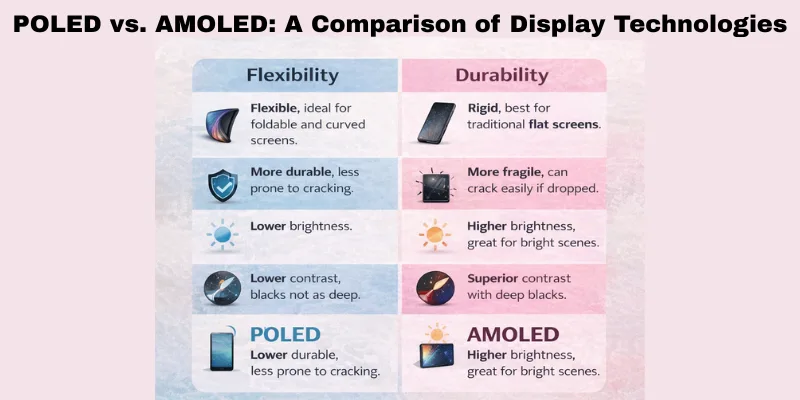
When choosing a display for your device, you might encounter POLED (Plastic OLED) and AMOLED (Active Matrix OLED). Though both are OLED technologies, they differ in key areas: display structure, durability, visual quality, and energy use.
Display Structure: Flexibility vs. Rigidity
- POLED uses plastic as the substrate, making the screen flexible. This allows for curved, foldable, and rollable designs, perfect for devices like foldable smartphones.
- AMOLED uses glass, making it rigid and less flexible, but offering a stable, solid foundation.
Durability: Flexible vs. Fragile
POLED’s plastic base makes it more durable and resistant to drops. It’s great for wearables or devices that need extra durability. AMOLED, with its glass substrate, is more fragile and may crack if dropped.
Visual Quality: Brightness and Contrast
- AMOLED excels in contrast and brightness, offering deeper blacks and better overall image quality.
- POLED is improving in these areas, but it still doesn’t match AMOLED in terms of contrast and brightness. However, it still provides good color accuracy.
Energy Use: Power Efficiency
- AMOLED is more energy-efficient for darker scenes because pixels turn off completely to show true blacks.
- POLED consumes slightly more power but remains energy-efficient overall, with technological improvements helping reduce this gap.
Which Display is Right for You?
- POLED offers flexibility and durability, making it ideal for foldable devices and wearables.
- AMOLED provides superior visual quality and better power efficiency in darker scenes, making it great for high-end smartphones.
Real-World Performance of POLED and AMOLED Displays
POLED (Plastic OLED) and AMOLED (Active Matrix OLED) are popular display technologies, each offering unique advantages. Let’s explore how they perform in real-world scenarios such as watching videos, gaming, and using devices in sunlight.
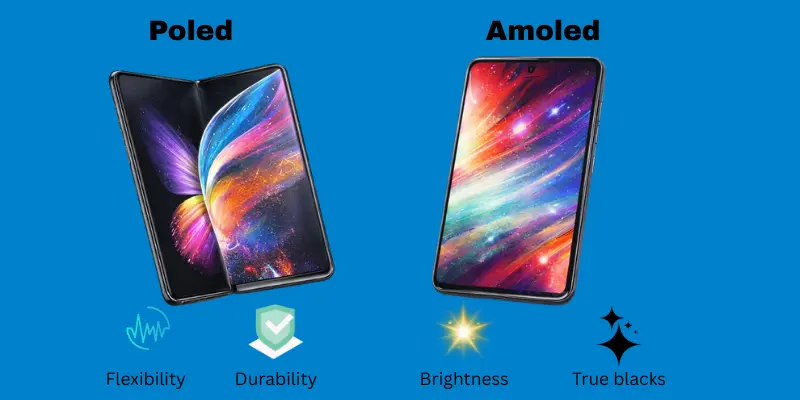
POLED Displays: Flexibility and Durability
POLED displays use a plastic substrate, making them flexible and durable, perfect for foldable devices like the Samsung Galaxy Z Fold and LG V40 ThinQ.
- Daily Tasks: Good color accuracy and clarity for browsing and social media, but not as vibrant as AMOLED.
- Watching Videos & Gaming: Performs well but lacks the contrast and brightness of AMOLED.
- Under Sunlight: Less bright compared to AMOLED, making it harder to see in direct sunlight.
AMOLED Displays: Vibrant Colors and Better Contrast
AMOLED displays use a glass substrate and are known for their vibrant colors, deep blacks, and high contrast, as seen in devices like the Samsung Galaxy S21 and OnePlus 9.
- Daily Tasks: Excellent contrast and vibrant colors make everything look vivid and sharp.
- Watching Videos & Gaming: Superior brightness and contrast for an immersive experience.
- Under Sunlight: Performs well in bright environments due to high brightness and clarity.
Key Differences Between POLED and AMOLED
- Structure: POLED is flexible (plastic), while AMOLED is rigid (glass).
- Durability: POLED is more durable and impact-resistant; AMOLED is more fragile.
- Visual Quality: AMOLED offers better contrast and brighter displays.
- Energy Efficiency: AMOLED uses less power for dark scenes, while POLED uses slightly more.
Final Thoughts
- POLED is ideal for flexible, durable devices like foldable phones.
- AMOLED excels in visual quality with vibrant colors and better outdoor visibility.
Choosing between POLED and AMOLED depends on whether you prioritize flexibility and durability (POLED) or color vibrancy and contrast (AMOLED).
POLED vs. AMOLED Displays: A Quick Comparison
When deciding between POLED (Plastic OLED) and AMOLED (Active Matrix OLED) displays, it’s important to understand their key strengths and weaknesses. Below is a simplified comparison table that highlights the main differences:
| Feature | POLED vs. AMOLED |
| Flexibility | POLED: Flexible, ideal for foldable and curved devices. AMOLED: Rigid, better suited for traditional flat screens. |
| Durability | POLED: More durable, less prone to cracking. AMOLED: More fragile, can crack easily if dropped. |
| Brightness | POLED: Lower brightness, may struggle in bright environments. AMOLED: Higher brightness, performs well in bright scenes. |
| Contrast | POLED: Lower contrast, blacks are not as deep. AMOLED: Offers superior contrast with true blacks. |
| Color Vibrancy | POLED: Good color vibrancy but less intense. AMOLED: Highly vibrant, offering vivid, rich colors. |
| Power Efficiency | POLED: Slightly less power-efficient with dark images. AMOLED: More power-efficient when displaying dark content. |
| Risk of Burn-in | POLED: Lower risk of burn-in. AMOLED: Higher risk of burn-in with static images. |
| Best For | POLED: Perfect for foldable, flexible, and durable devices. AMOLED: Ideal for devices needing high contrast and vibrant colors. |
How to Choose the Right Display for Your Needs
When picking between POLED (Plastic OLED) and AMOLED (Active Matrix OLED) displays, the right choice depends on your needs. Here’s a quick guide to help you decide.
For Gamers and Media Lovers: AMOLED
AMOLED displays are perfect for gaming and media consumption due to their vibrant colors, deep blacks, and high contrast. Devices like the Samsung Galaxy S21 offer an immersive experience for video and gaming.
For Fans of Foldable Phones: POLED
If you’re into foldable or curved devices, POLED is the better choice. Its flexible plastic design makes it more durable and suited for devices like the Samsung Galaxy Z Fold.
For Budget vs. Premium Buyers: POLED or AMOLED
- POLED is more affordable, making it great for budget-conscious buyers.
- AMOLED is found in premium devices, offering superior brightness and contrast for those who want the best display quality.
Quick Recap:
- AMOLED: Best for vibrant visuals and high contrast for gaming and media.
- POLED: Ideal for foldable devices and more affordable options.
POLED vs AMOLED: Myths and Facts
When it comes to POLED and AMOLED displays, there are many myths out there. Let’s clear up the confusion and break down the real differences.
1. Super AMOLED vs AMOLED
- Myth: “Super AMOLED” is much better than regular AMOLED.
- Fact: Super AMOLED is just a marketing term used by Samsung. It refers to AMOLED screens with a built-in touch layer, but the display quality is the same as standard AMOLED.
2. POLED is Inferior to AMOLED
- Myth: POLED displays are worse than AMOLED displays in terms of quality.
- Fact: POLED and AMOLED are both great. POLED uses plastic, which makes it more flexible and durable, especially for foldable devices. AMOLED is made with glass, but both deliver vibrant colors and deep blacks.
3. AMOLED Saves More Battery Than POLED
- Myth: AMOLED is always better for battery life than POLED.
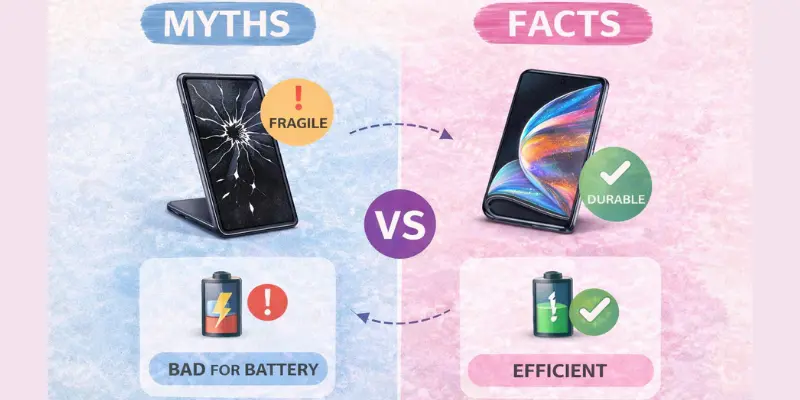
- Fact: While AMOLED can be slightly more power-efficient in dark scenes (as black pixels turn off), POLED is also energy-efficient and has been improving in this area.
4. POLED Displays Are Fragile
- Myth: POLED screens are fragile because they use plastic.
- Fact: POLED displays are actually more durable than AMOLED screens because the plastic makes them less prone to cracking, which is great for foldable phones.
Final Thoughts: POLED vs AMOLED
- Super AMOLED is just a branded version of AMOLED with no significant difference in quality.
- POLED and AMOLED are both excellent, but POLED is better for flexibility and durability.
- AMOLED has slightly better brightness and contrast, but POLED is catching up.
Now that you know the facts, you can make an informed decision between POLED vs AMOLED, whether you’re looking for a foldable device, gaming experience, or battery efficiency.
Conclusion
So guys, in this article, we’ve covered POLED vs. AMOLED in detail. If you’re someone who loves flexible designs and durability, especially for foldable phones or wearables, I’d recommend going with POLED. However, if you’re looking for stunning display quality with vibrant colors and high contrast for media and gaming, AMOLED is the way to go. Whatever you choose, make sure it suits your needs! Let me know which display you prefer, and feel free to share your thoughts in the comments below!
FAQs
POLED uses a plastic substrate, which makes it more flexible and durable. AMOLED uses glass, which provides a rigid structure and slightly better contrast. Both offer vibrant colors and deep blacks, but POLED is better for foldable devices.
It depends on your needs. POLED is great for foldable or flexible devices, while AMOLED offers better brightness and contrast for media. Both are excellent technologies; the best choice depends on what features matter most to you.
Yes! POLED displays are flexible, so they are perfect for devices with curved or foldable screens. This flexibility is one of the main advantages of POLED over AMOLED.
AMOLED may last slightly longer in terms of color quality, but POLED is more durable because it’s less likely to crack. POLED’s plastic base gives it better resistance to drops or impacts.
AMOLED displays can turn off individual pixels to show true black, resulting in higher contrast. POLED does this too, but the black levels and overall contrast aren’t quite as deep as in AMOLED screens.
Not much, but AMOLED is slightly more efficient for darker scenes because black pixels are completely turned off. POLED may use a little more power, but the difference is minimal in most everyday usage.
Yes, generally POLED displays are more affordable than AMOLED. This makes them a great choice for budget-conscious buyers while still offering solid performance.
While most foldable phones use POLED displays because of their flexibility, some high-end devices might use AMOLED. However, POLED is usually the preferred choice for foldable and flexible screens.
If you’re into gaming and watching movies, AMOLED is likely the better choice. The vibrant colors, high contrast, and deep blacks in AMOLED provide a more immersive viewing experience.
“Super AMOLED” is just a branded version of AMOLED with a touch layer integrated into the display. It doesn’t offer major improvements in terms of color or brightness, but it makes the display thinner and more responsive.




- Be Respectful
- Stay Relevant
- Stay Positive
- True Feedback
- Encourage Discussion
- Avoid Spamming
- No Fake News
- Don't Copy-Paste
- No Personal Attacks
- Be Respectful
- Stay Relevant
- Stay Positive
- True Feedback
- Encourage Discussion
- Avoid Spamming
- No Fake News
- Don't Copy-Paste
- No Personal Attacks
