What Are Megapixels and Why Do They Matter in Photography?
Published: 2 Sep 2026
Not sure what megapixels are or why they matter in photography? You’re not alone! Many people see the word “megapixel” on camera specs but don’t fully understand its role. In this guide, we’ll clear up the confusion. We’ll explain what megapixels really mean, how they affect your photos, and why they matter when choosing a camera. By the end, you’ll have a better idea of how megapixels can impact the quality of your pictures.
Introduction to Megapixels
Megapixels are often mentioned when talking about cameras, but what do they really mean? In this section, we’ll explain how megapixels affect photo quality and why they matter when choosing a camera.
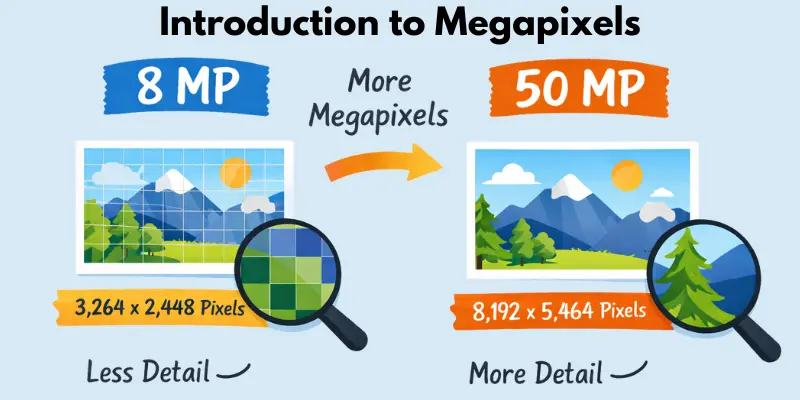
What Are Megapixels?
Megapixels are the number of tiny pixels that make up an image. More megapixels mean more detail in your photo. For example, an 8 MP smartphone camera like the iPhone captures good quality for everyday use, while a 50 MP professional camera provides sharper, clearer images, especially when zoomed in or printed large.
Higher megapixels improve photo clarity and detail, which is important for professional photography. For casual shots, a lower megapixel count is fine, but for larger prints or detailed work, more megapixels are better.
Why Do Megapixels Matter in Photography?
Think of megapixels like puzzle pieces—the more pieces you have, the clearer the image. More megapixels mean more detail and higher resolution. In photography, this matters when printing photos or cropping them. A 12 MP photo might blur when enlarged, but a 20 MP photo stays sharp, even when zoomed in. The more megapixels, the better the clarity, especially for large prints or detailed edits.
Megapixels vs Resolution: What’s the Difference?
People often mix up megapixels and resolution. But they are not the same thing. Let’s break it down in simple terms.
Megapixels tell you the total number of pixels in a photo. One megapixel equals one million pixels. It’s just one number, like “12 MP” or “50 MP.”
Resolution tells you how those pixels are arranged. It shows the width and height in pixels, like 4000 x 3000. This grid gives you the shape of the image, not just the total count.
Here’s a simple formula to find megapixels:
Width (in pixels) × Height (in pixels) ÷ 1,000,000 = Megapixels
For example, a 4K video frame is 3840 x 2160 pixels. Multiply those numbers, and you get about 8.3 million pixels. So, 4K video is only 8.3 MP. That’s less than most smartphone camera photos!
Why does this matter?
Two cameras can have the same megapixel count but different resolutions. A 12 MP photo could be 4000 x 3000, or it could be 6000 x 2000. The shape changes, even if the pixel count stays the same. This affects how the photo looks and fits on different screens or prints.
Quick takeaway:
- Megapixels = total pixel count (one number)
- Resolution = pixel layout (width x height)
- More megapixels usually means higher resolution, but they’re not identical terms
Next time you see a camera spec, you’ll know exactly what each number means. Simple, right?
Debunking Common Megapixel Myths
Many people believe that more megapixels automatically mean better image quality. But this isn’t always the case. In this section, we’ll clear up this myth and explain what really affects photo quality.
More Megapixels = Better Photos?
More megapixels don’t always mean better photos. For example, a 16 MP camera might take better shots than a 20 MP camera if the sensor quality is lower.
The real factors are sensor size, lens quality, and image processing. A better sensor captures more light, improving clarity, especially in low light. So, megapixels matter, but they’re not the only thing that determines photo quality.
What Actually Matters in Image Quality?
Megapixels aren’t the only thing that affects image quality. Sensor size, lens quality, aperture, and image processing also play key roles. A larger sensor captures more light, improving low-light performance and making photos brighter. A high-quality lens enhances sharpness and reduces distortion, leading to clearer images.
For example, a camera with fewer megapixels but a great sensor and lens will likely produce better photos, especially in low light, compared to a high MP camera with a poor sensor and lens. Quality matters more than quantity when it comes to image detail.
How Many Megapixels Do You Really Need?
When it comes to choosing the right camera, the number of megapixels can be confusing. But the truth is, how many you need depends on what you’re using the camera for. Let’s break it down based on different needs.
For Casual Users (Smartphones and Social Media)
For everyday users, you don’t need a high megapixel count. A camera with 8-12 MP is more than enough for casual photos and social media posts. Social media platforms often compress images, making the difference between a 12 MP photo and a 50 MP photo almost invisible for casual viewing.
- 8-12 MP is enough for everyday use.
- Social media compresses images, reducing megapixel importance.
- Quality differences are hard to notice for casual viewing.
For Photography Enthusiasts (DSLR and Mirrorless Cameras)
For hobbyists and intermediate photographers, a range of 16-24 MP is ideal. It provides a good balance between high-quality photos and manageable file sizes, making it easier to edit and share. Cameras like the Canon EOS Rebel T7 (24 MP) are great for enthusiasts who want both quality and flexibility.
- 16-24 MP is great for hobbyists.
- Offers a balance between photo quality and file size.
- Ideal for enthusiasts who enjoy editing and sharing.
For Professional Use (Commercial and High-Resolution Photos)
For professional photographers, especially those working with large prints or commercial photos, higher megapixels (30 MP and above) are essential. More megapixels allow for clearer, more detailed images and provide flexibility for cropping or enlarging without sacrificing quality.
- 30 MP and above are necessary for professional work.
- Great for large prints or commercial photography.
- Essential for cropping and maintaining image quality.
How Many Megapixels Do You Need for Printing?
Want to print a big poster or a small photo? The megapixels you need depend on the print size. Let’s make this easy with some real numbers. Photo quality for print depends on DPI (dots per inch). Higher DPI means sharper prints, but it also needs more megapixels.
Here’s a simple guide:
- 4 x 6 inches: ~0.4 MP (good quality) or ~1.6 MP (best quality)
- 8 x 10 inches: ~1.2 MP (good quality) or ~5 MP (best quality)
- 12 x 18 inches: ~5 MP (good quality) or ~19 MP (best quality)
- 16 x 24 inches: ~9 MP (good quality) or ~35 MP (best quality)
- 40 x 60 inches: ~14 MP (good quality) or ~54 MP (best quality)
Why does viewing distance matter?
Big prints like posters and billboards are viewed from far away. So they don’t need as many megapixels per inch. A 24 MP photo can look sharp on a billboard, even though the same megapixel count wouldn’t work for a close-up print. Small prints, like photo frames or ID cards, are viewed up close. These need higher DPI, and so more megapixels, to stay sharp.
Quick tip for you:
- Printing family photos or frames? 8-12 MP is enough.
- Printing large wall art or posters? Aim for 20+ MP.
- Making a billboard or banner? Don’t worry about MP count. Viewing distance saves the day.
The Role of Megapixels in Different Devices
Megapixels play a different role depending on the device you’re using. Whether it’s a smartphone, professional camera, or security system, understanding how megapixels impact image quality can help you make the best choice for your needs.
Megapixels in Smartphone Cameras
For most smartphone users, a 12 MP camera is enough for clear photos shared on social media. While megapixels matter for detail, sensor quality, lens, and image processing play a bigger role in overall photo quality. A 50 MP phone may show more detail when zoomed in, but for everyday use, the difference is minimal.
- 12 MP works fine for casual photos.
- Sensor quality and lens are more important than megapixels.
- A 50 MP camera shows more detail when zoomed or cropped.
Megapixels in Professional Cameras
For professionals, 30 MP or higher cameras are necessary for detailed shots, especially for large prints. These cameras capture fine details and allow for cropping or zooming without losing quality. A 50 MP camera, for example, is perfect for billboards or magazine covers.
- 30 MP+ is ideal for professional work.
- Great for large prints and detailed shots.
- Allows more flexibility for cropping and zooming.
Megapixels in Security Cameras
In security cameras, higher megapixels, like 5 MP or 8 MP, capture more detail than a 2 MP camera. While megapixels matter, factors like placement, lens quality, and night vision also affect performance. Higher MP cameras help with clearer footage for face or license plate recognition.
- 5 MP or 8 MP provides clearer details than 2 MP.
- Camera placement and night vision are important, too.
- Higher megapixels improve recognition in security footage.
Real-World Examples: Megapixels in Action
To truly understand the impact of megapixels, it’s helpful to see them in action. Let’s compare real-world examples of photos taken with different megapixel cameras to highlight the differences in detail and storage needs.
Comparing Photos with Different Megapixels
Let’s imagine you take the same landscape photo using three cameras: 8 MP, 24 MP, and 50 MP.
At normal viewing size, all photos look good. You may not see much difference on your phone screen. But once you zoom in or crop the image, the change becomes clear.
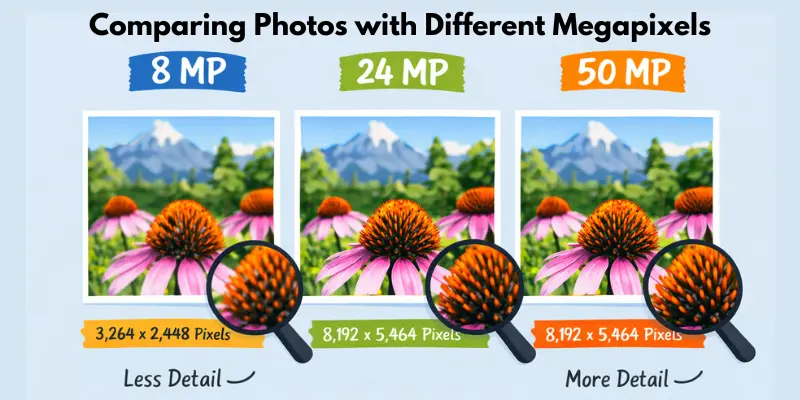
- 8 MP: Details start to blur when you zoom in. Trees and faces look soft.
- 24 MP: Much sharper. You can crop and still keep clear details.
- 50 MP: Very sharp. Small textures like hair, leaves, or fabric stay clear even after heavy zoom.
For example, in a portrait photo, the 50 MP image keeps skin texture and eye detail, while the 8 MP version loses clarity.
However, lighting and lens quality still matter. A good lens with proper lighting can make a 24 MP photo look better than a poorly shot 50 MP image.
Impact on Storage and File Size
More megapixels also mean bigger photo files because the camera stores more data.
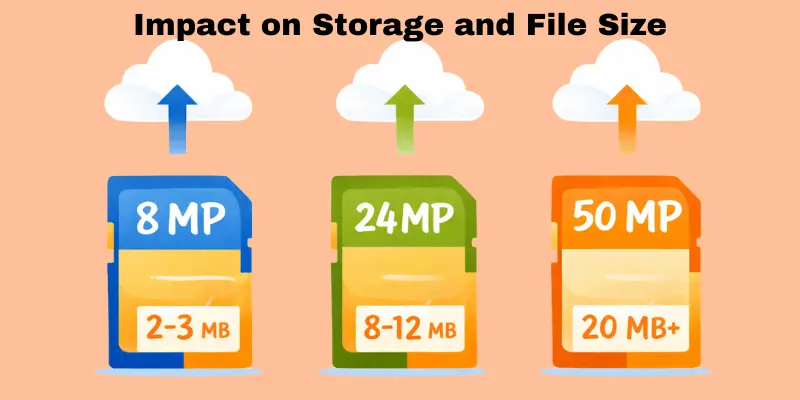
- An 8 MP photo may take around 2–3 MB
- A 24 MP photo may take around 8–12 MB
- A 50 MP photo may take 20 MB or more.
If you take many photos, storage fills up quickly. Your phone, memory card, or computer will need more space. Editing also becomes slower because larger files need more processing power.
So people using high-MP cameras often upgrade:
- bigger SD cards
- external hard drives
- cloud storage plans
More megapixels give more detail, but they also demand more storage and speed.
Other Key Factors in Camera Quality
While megapixels are important, other factors like sensor size, aperture, lens quality, and ISO play a huge role in the overall image quality. These elements can make a bigger difference, especially in challenging lighting conditions.
Sensor Size and Aperture
Sensor size and aperture are more important than megapixels, especially in low light. A larger sensor, found in DSLRs and mirrorless cameras, captures more light, resulting in brighter, clearer photos in darker settings. Smaller smartphone sensors may struggle in low light, creating grainy images. A larger aperture (smaller f-number) allows more light, improving exposure and depth of field.
- Larger sensors capture more light for better low-light photos.
- Bigger apertures improve exposure and depth of field.
- Smaller sensors can result in grainy photos in low light.
Lens Quality and ISO
Lens quality and ISO settings greatly impact image quality. A high-quality lens reduces distortion and sharpness loss, ensuring clearer photos. ISO controls brightness, but a higher ISO introduces more noise. For example, a smartphone with high ISO may look grainy, while a DSLR with a good lens and lower ISO gives clearer results.
- Good lenses reduce distortion and improve sharpness.
- High ISO helps in low light but adds noise.
- DSLRs with quality lenses and lower ISO produce cleaner images.
When Should You Choose Higher Megapixels?
In this section, we will look at the pros and cons of choosing higher megapixels in your camera. While there are clear benefits, there are also a few downsides to consider.
Advantages of Higher Megapixels
Higher megapixels are useful for detailed photography, but they also offer other benefits. Here are some of the key advantages:
- Better for large prints without losing sharpness.
- More details for cropping and zooming into images.
- Ideal for professional photography and commercial use.
- Allows for clearer and more detailed photos in high-resolution work.
- Gives flexibility for editing without losing image quality.
Disadvantages of Higher Megapixels
While there are advantages, higher megapixels come with some challenges. Here are the main disadvantages:
- Larger file sizes take up more storage space.
- Slower processing and editing times, especially on older devices.
- Requires faster memory cards for handling larger files.
- May not show a noticeable improvement for casual users.
- More storage and backup solutions are needed for high MP photos.
Final Thoughts
Key Takeaways
In summary, megapixels are an important factor in photo quality, but they’re not the only one. While a higher megapixel count can provide more detail, other factors like sensor size, lens quality, and aperture are just as crucial. For casual users, a lower megapixel camera is usually enough, while higher megapixels are better for enthusiasts and professionals who need detailed photos, large prints, or the ability to crop without losing clarity.
- Megapixels matter, but sensor size, lens, and aperture are key.
- Casual users can get by with 8-12 MP.
- Enthusiasts and professionals need 16-24 MP or 30+ MP for better detail and large prints.
Choosing the Right Megapixels for Your Needs
To choose the right megapixels for your needs, consider what you’ll be using the camera for:
- Casual Users: Go for cameras with 8-12 MP, perfect for social media and everyday photos. Popular options include smartphones like the iphone 12 (12 MP) or Samsung Galaxy S21 (12 MP).
- Photography Enthusiasts: Cameras with 16-24 MP are ideal for more flexibility and detail. Models like the Canon EOS Rebel T7 (24 MP) or Sony Alpha A6000 (24 MP) are great options.
- Professionals: For high-resolution work, choose cameras with 30+ MP. Popular models include the Canon EOS 5DS (50 MP) or Nikon D850 (45 MP), perfect for commercial photography or large prints.
By understanding your needs, you can choose the right camera with the right megapixels to match your photography goals.
Conclusion
So, we’ve covered why megapixels matter in photography. While megapixels are important, other factors like sensor size and lens quality also play a big role. Whether you’re a casual user or a pro, understanding megapixels helps you pick the right camera. My tip? For everyday use, an 8-12 MP camera is enough. But if you’re getting serious about photography, aim for 16 MP or higher for more detail and flexibility. Stay tuned, guys, and keep learning!
FAQs
Megapixels refer to the number of pixels in an image. One megapixel equals one million pixels. The more megapixels a camera has, the more detail it can capture. However, higher megapixels alone don’t always guarantee better photo quality.
Not necessarily. While more megapixels can help with larger prints or cropping, they don’t automatically make photos better. Other factors like sensor size, lens quality, and image processing are just as important for photo quality.
Most smartphones today come with cameras ranging from 8 to 48 megapixels. For casual users, 12-16 MP is usually enough for clear, high-quality photos. Higher megapixels may offer more detail, but the difference is often hard to notice in everyday use.
Yes, more megapixels allow for larger prints without losing sharpness. A photo with higher megapixels can be printed in bigger sizes while maintaining clarity. For example, a 50 MP photo can be printed as a large poster without becoming pixelated.
Yes, higher megapixels create larger image files. Larger files take up more storage space on your phone, memory card, or computer. If you frequently take high-resolution photos, you may need additional storage or faster memory cards to handle the larger files.





- Be Respectful
- Stay Relevant
- Stay Positive
- True Feedback
- Encourage Discussion
- Avoid Spamming
- No Fake News
- Don't Copy-Paste
- No Personal Attacks
- Be Respectful
- Stay Relevant
- Stay Positive
- True Feedback
- Encourage Discussion
- Avoid Spamming
- No Fake News
- Don't Copy-Paste
- No Personal Attacks
